
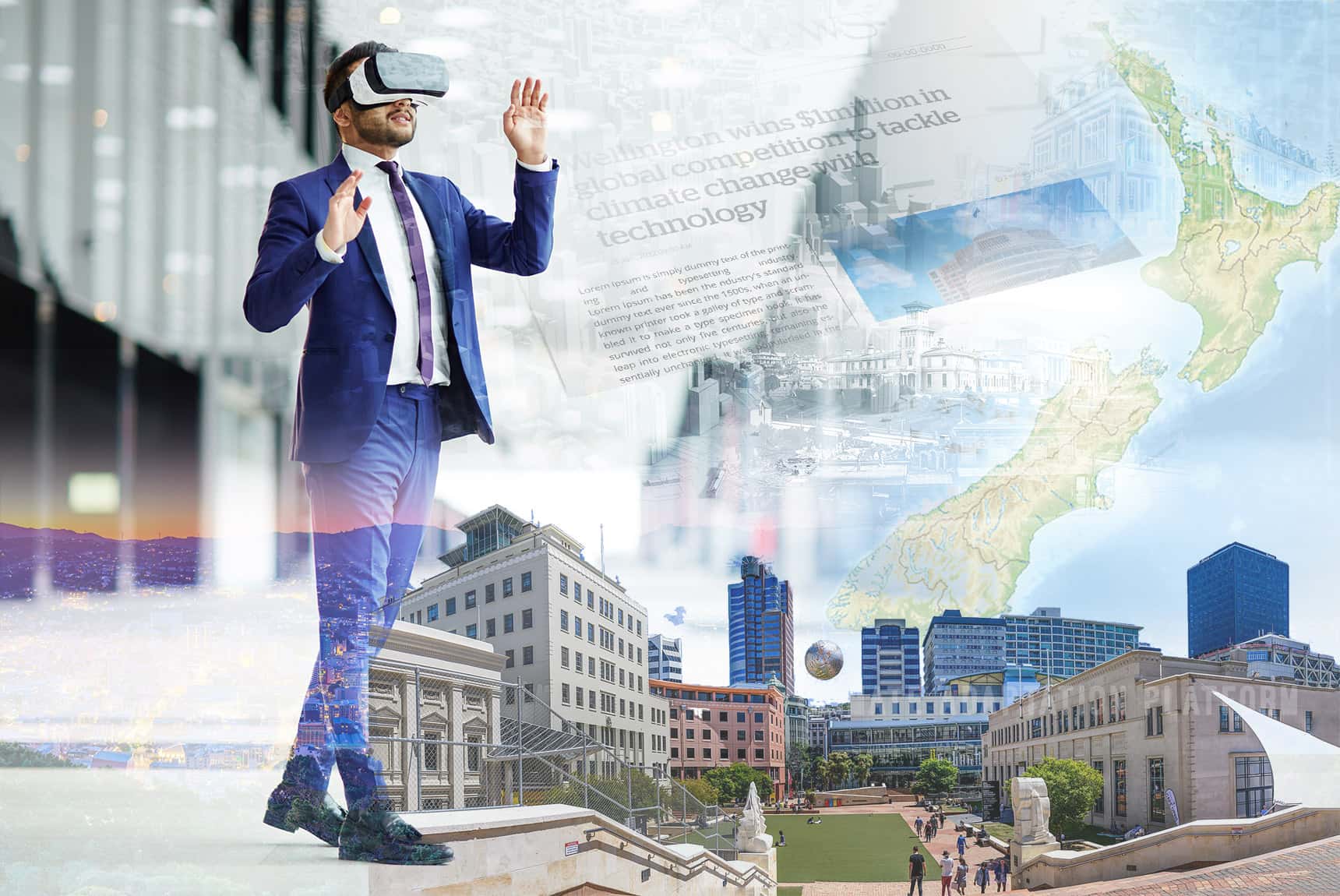
The usual situation in Wellington is slowly turning into alternating waves of extreme heat and drought. To reshape urban infrastructure in a safer and more sustainable manner, Her municipality launched the Digital Twin Project that made it the first New Zealand city to win a global challenge for best government innovation for mayors.
The effects of climate change are evident in all walks of life, Such as the environment, the economy and daily life, This calls for accelerating the efforts of governments and international organizations to face the new reality. In an endeavor that will determine the course of the global future.
These efforts peak in cities, It is the source of 70% of the world’s carbon emissions, and the consumer for two-thirds of his energy. The construction sector alone, Representing 38% of total energy-related emissions, Which reached its highest level in 2019 at the equivalent of 10 gigatons.
In Wellington, New Zealand, According to the National Institute of Water and Atmospheric Research, One of the most important government research institutions in the country, A set of climatic phenomena that are likely to be witnessed by the city and its surroundings, Starting with extreme weather conditions and increasing their frequency, Through the difficulty of managing and predicting agricultural areas and water supplies, Not ending with a 1.4-meter rise in sea levels, This will change the coastal geography and cause storms and floods to intensify.
With the CBD accounting for 77% of the city’s GDP, These changes will have profound economic implications, New Zealand’s Department of Environment has already estimated the economic impact of climate change at $840 million over a decade between 2007 and 2017. Going forward, This damage will affect about 10 percent of private property to incur the economy $ 7 billion, along with another billion municipal council property losses, who will lose a quarter of the annual real estate fees.
In search of technological solutions for infrastructure management and refurbishment, The municipality chose to launch the Digital Twin project that led it to win a million dollars in the Global Mayors Challenge.
The Bloomberg Philanthropies awards this award to the most ambitious urban innovations, Which stems from approaches to contemporary issues such as economic recovery and development, health and well-being, climate and environment, and gender equality. This year’s challenge attracted 631 entries from different parts of the world. 50 of them were selected in the first qualifier, Before 15 projects were declared winners, Among them is the Digital Twin Project in Wellington.
Digital twin technology is a program to which real data of a physical entity such as a building or service is entered. He uses them to create computer simulations, The performance, quality and resistance of this element can be predicted through them. This is like drawing a dynamic landscape that shows, for example, the island’s thermal impacts, pollution, climate change, energy consumption and resource management. Then This three-dimensional model is presented to citizens and decision-makers.
In practical application, The city will appear to users as if it were a digital game, But they cannot create avats or interact with their elements. The screen provides a look at the current situation, It allows comparison with the past or the future and suggests ways of protection against future phenomena, Such as countering rising tides by building fences or intensifying the planting of mangroves, It provides buildable estimates of the cost and duration required. Augmented reality technology can also be applied where anyone can head to the area and pick up their phone to see a visualization of the proposed app.
For the implementation of the project, The digital innovation team at the municipal council worked on collecting height data, aerial photographs and three-dimensional models of buildings, It will add historical data, temperature forecasts, sea levels and a model of storm intensity. The team focused on encouraging community participation, Residents shared their experiences with climate change and their proposals to address it. The developers also studied the possibility of using this advanced tool by the indigenous people to identify important locations. The model also included extrapolation of the region’s topographic development and land use. More importantly, is that the process did not stop at portraying the present and imagining the future, It even focused on studying the past as well.
Wellington’s digital twin will protect future generations from the consequences of climate change, which will impose on them a new reality of more violent storms and sea level rise. The greatest responsibility for adapting the city and its inhabitants to this reality will lie with the city authorities. Such a project is also an opportunity to represent the city’s environmental problems in a map that enables researchers and residents to interact with environmental challenges. This contributes to bringing the scientific language about climate change closer to the public and communicating the idea to them in ways that are easy to understand.
Due to the complexity of the process, The digital innovation team appreciates that the completion of the full virtual representation of the city will require a lot of intensive work which should be fast and committed to the deadline set by the donor institution, Which amounted to 3 years. During this period, the municipal authorities will work to develop and expand the idea to make it a realistic program that improves people’s lives.
Specialists believe that the creation of an overly realistic simulation may enhance the presence of the scientific projection methodology again, It gives people a sense of genuine connection to what they see.
In the same vein, Digital forecasts support authorities to improve design, construction, operations and management, It can be built on the thermal island effect and population density and traffic data to plan green areas, Identification of infrastructure needs, and programming traffic lights, Improving the environmental reality and other effects that achieve effective participation of citizens and sustainable urban development.
In addition to making the experience available to other coastal cities to benefit from, The municipality will invest the prize money in further developing its digital twin, to achieve its goal of reaching zero carbon emissions by 2050.
References:
- https://wellington.govt.nz/climate-change-sustainability-environment/climate-change/climate-change-in-wellington/how-will-climate-change-impact-wellington
- https://wellington.govt.nz/news-and-events/news-and-information/our-wellington/2022/01/bloomberg-challenge
- https://www.stuff.co.nz/environment/climate-news/127528198/wellington-project-puts-climate-change-into-the-video-game-world-with-1m-award