

To raise the efficiency of winter operations at Oslo Airport, Norway is moving towards making significant investments in self-driving dredging vehicles. Through cooperation between the public and private sectors to enhance efficiency and safety measures at the airport. In this rapidly changing age, Major airports are racing to provide more efficient and advanced services, and adopt new technologies to streamline its operations, Employing environmentally friendly solutions, Today, this has become a priority on the agenda of any entity or institution.
To give passengers a positive experience at airports, Timeliness and operations must remain stable while achieving maximum cost-effectiveness, It is a challenge that grows even more difficult in winter, Especially with the formation of ice and the accumulation of snow, Runways should be completely snow-free in order for flights to depart and arrive on time and safely. This requires enormous human resources and staff ready to work even in the harshest conditions.
In Norway, Oslo Airport management found that autonomous vehicle technology has reached a sufficient stage of maturity to be used in regular operations. For this reason, Avenor decided to implement a concept that years ago was just an idea on paper. Thus, The state-owned company, which operates under the supervision of the Ministry of Transport, Working towards the future of winter operations, It launched the Fully Committed to Autonomous Vehicles initiative to clean runways.
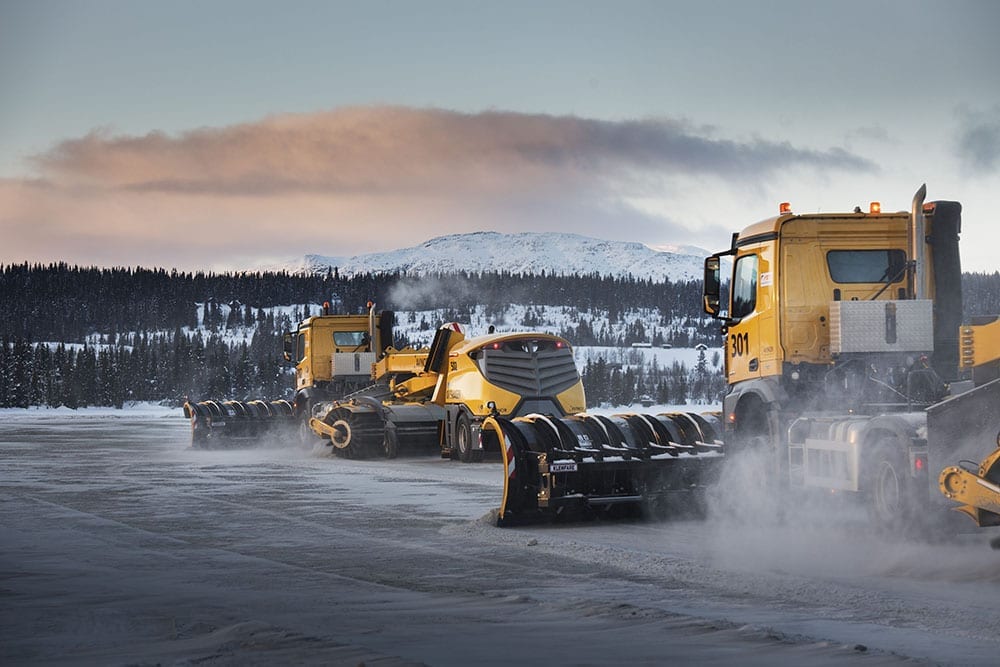
To fulfil this obligation, The company selected a private provider to enter into an 8-year contract for the purchase of snow buckets and sweeping vehicles. The contract is worth up to €40 million including the purchase of machinery and its ongoing maintenance. It starts with a down payment of twelve self-driving vehicles to be purchased from a Norwegian company. Which will be operated through a control center and special technological systems developed by one of the private sector partners in this project. Besides the supply of autonomous vehicles, The project includes the delivery of vehicles to all Avenue airports. Which owns about 150 vehicles for sweeping airport runways, The plan is to deploy several of these vehicles at Oslo Airport during the winter of 2021/2022.
This type of operation requires vehicles programmed for “wire driving” or adjustable to allow this option. This term refers to the replacement of hydraulic and mechanical systems in cars with sensor-based electronic control units that automatically try to avoid collisions with other vehicles, for example, Which is added to other aspects that make these compounds safer. In this project, Vehicles are equipped with brakes and throttle valve, It is the engine power control, Along with routing tools, GPS and a fourth-generation network. These bulldozers are 20 meters long and 5 and a half meters wide. It is eligible to clean 357,500 square meters per hour.
It is possible to plan the operations of these vehicles in advance, where the operator enters the airport specifications into the system, An easy-to-use tool is activated to perform tasks by specifying the route, the number of vehicles, their distribution, speed, and equipment settings such as bulldozer, brush, fan and chemicals. Once this stage is completed, The operation phase begins where the user can choose one of the available vehicles for each task and start autonomously, But this does not negate the ability of a single machine to perform several tasks at the same time.
The operating system allows changing the plans of operations according to several alternatives that take into account the weather and traffic conditions, While ensuring that the workflow from the control room is closely monitored and can be stopped and resumed and settings adjusted by the operations manager or the operator on site for safety purposes, He usually drives the first vehicle. Before operating, The system conducts a safety assessment, It adds different types of guardrails. On the ground, The driver does not perform any operational tasks, However, he can temporarily or permanently stop the process if he detects any threats or risks.
The basic program is to close the runways for 15 minutes so that the vehicles perform cleaning and snow removal tasks efficiently, Each cleans part of the floor, They operate in pairs that move in harmony and are monitored by the on-cab administrator to monitor the process during the testing and learning phases before starting autonomy.
More broadly, The project includes other long-term objectives, Among them is enabling these mechanisms to perform other tasks and services within the airport perimeter, such as mowing grass, drawing land lines, and others. It is worth noting that the open nature of airport runways and the absence of traffic avoid autonomous vehicles many of the challenges that hinder their deployment on public roads and make their task much simpler.
Since these mechanisms have high capacity and great accuracy, Management can hire fewer of them, thus achieving greater efficiency in the use of equipment, This will benefit its budget and the environment in terms of reducing the percentage of operations. The automated concept of winter operations will also allow airport authorities to carry out their tasks with fewer resources and when needed.
generally This future move will put Oslo Airport at the forefront of the innovation race in the sector, This will enable it to increase the efficiency of its winter operations over the coming years.
References: