

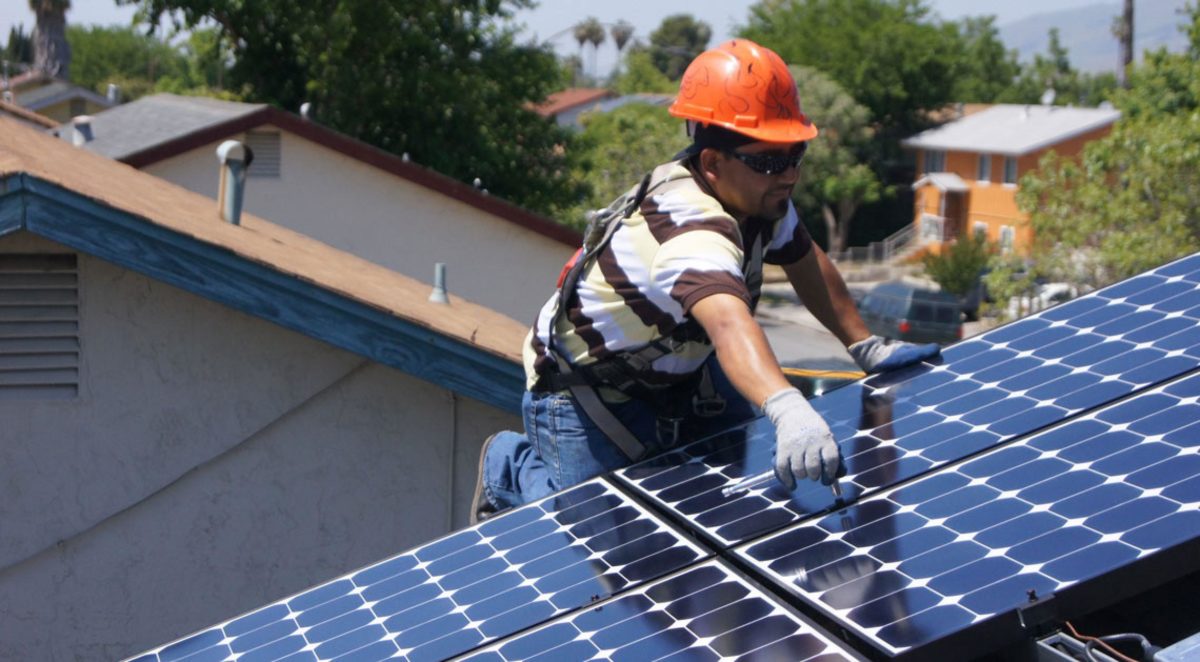
To accelerate the pace to reach net-zero, the goal of the mid-twenty-first century, the United States government has devised a new way to reduce the burden of bureaucracy on owners of renewable energy projects, solar in particular, through an online platform that examines the project’s plan and automatically grants it legal permit, reducing transaction time from weeks to minutes.
At the 27th Conference of the Parties to the Framework Convention on Climate Change (COP27), the US administration affirmed its adherence to the goals of the United Nations to solve the planet’s crisis, achieving human, economic and environmental security, and reaching net-zero by 2050.
Ambitious targets, governed by a narrow window of time, that require intensive efforts involving tens of thousands of technicians working to create solar systems in all US states. The government has the additional goal of getting 100% clean electricity by 2035, a goal deterred by the realisation that any path the state takes towards climate neutrality must go through the decarbonisation of the electricity sector, which serves all other sectors.
Following this trend, solar cell projects have proliferated at all levels, small ones such as rooftop-mounted cells and large solar farms spanning large areas. Many owners of those projects have suffered delays owing to the complexity of the permit process. Also, this phenomenon varies from state to state, each according to its own laws and requirements. In some cases where the complexity of the procedures has reached its peak, companies become reluctant and residents stop even trying.
Solar permitting can be a major bottleneck for residential solar installations. That’s why the National Renewable Energy Laboratory (NREL) worked with local governments, building code organisations, permitting software providers, and industry partners to develop an online platform known as SolarAPP+ to enable instant local permitting of rooftop solar installations.
SolarAPP+ provides local governments with a standard portal for receiving and processing permit information for residential solar and solar+storage systems. The portal conducts an automated permitting review for safety and code compliance, enabling local governments that adopt the tool to approve solar permits instantly. Hence, SolarAPP+ instantly issues permits for code-compliant residential rooftop solar photovoltaic (PV) systems.
The platform mainly aims to advance the goals of clean energy, as federal and local policies were not sufficient to achieve the desired results, nor were they sufficient to reduce equipment costs, as the solar energy accounts for about 3% of U.S. electricity. Also, the ease of installation processes is matched by the difficulty in obtaining government permits, which may take weeks or even months due to the complexity of bureaucratic procedures and the severe shortage of government personnel, which may cause frustration among homeowners and service providers alike.
This is only a small part of the waiting periods experienced by owners of major projects aspiring to build large-scale solar energy systems, as no investor may choose to freeze their financing for years, pending legal approvals.
SolarAPP+ allows developers to check code compliance of designs before submitting them for permit approval. If the application is related to the installation of a solar energy system in a house, it is estimated that issuance of the permit takes 15 to 60 minutes.
SolarAPP+ was tested in four communities in Arizona and California. The platform management continues to work with jurisdictions to come up with a standardised format for the processes and requirements that developers must meet to obtain permits.
To encourage local governments to use the application, the Department of Energy (DOE) launched a special prize for it and awarded it to the city of Denver, whose local authorities, represented by the Community Planning and Development Department, were the first to participate in DOE’s initiative, after granting permissions for nearly 3,800 solar energy projects in the previous year.
California, one of the active states in clean energy, launched an incentive programme called CalAPP, which provides grants and assistance for cities and counties to adopt the SolarAPP+. The initiative attracted dozens of local administrations in the state and reimbursed staff time along with the many resources a local authority needed to adopt the app.
Since its launch, the platform has granted permits to more than 10 thousand projects in different cities, saving more than 10 thousand hours. These figures are translated into a two-week reduction in the schedule for each project, which means a faster reduction of the cost of conventional electricity as well.
In the long run, it is hoped that this software will contribute to facilitating permit issuances and reducing red tape and bureaucratic procedures, saving time, effort and cost for citizens, local governments and service providers, and maintaining momentum in the United States of America’s goal of decarbonizing the U.S. electricity grid by 2035.
References:
- https://www.nytimes.com/2023/02/23/climate/renewable-energy-us-electrical-grid.html
- https://pv-magazine-usa.com/2022/09/28/california-law-to-require-automated-instant-rooftop-solar-permits/
- https://www.energy.gov/eere/solar/streamlining-solar-permitting-solarapp
- https://www.energy.gov/eere/solar/articles/new-solar-permitting-prize-everyone-winner
- https://www.whitehouse.gov/wp-content/uploads/2021/10/US-Long-Term-Strategy.pdf
- https://calssa.org/