
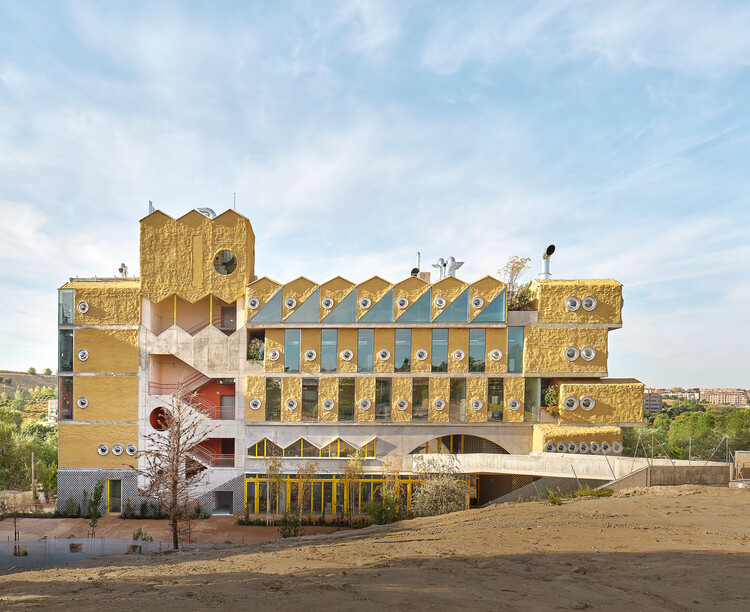
In the heart of Madrid, Spain’s capital, a pioneering educational project has emerged, challenging traditional notions of school design and offering a new approach to sustainability. The ” Colegio Reggio” was launched to redefine architectural practices, integrate a unique educational philosophy that places children at the heart of the learning journey, and combine education with innovation and sustainability.
As societies prepare future generations for future challenges, the role of education extends beyond the transmission of traditional knowledge. It involves nurturing innovative thinkers, responsible citizens, and environmentally conscious individuals. This means creating educational institutions and curricula that redefine the concept of school.
The reality is that current education systems often struggle to meet the demands of sustainability and inclusive learning. Sustainability solutions and advanced technologies are typically associated with expensive budgets, making them unattainable for most educational institutions, except those funded by governments with strong economies, corporations, or major organizations.
In Southern Europe, for example, because environmental sustainability often involves larger financial investments, there is a pressing need for cost-effective and environmentally friendly educational facilities. Additionally, traditional educational models fail to foster innovation and experiential learning, which are crucial elements for developing future generations, on whom the hopes of sustainability rest.
Among hundreds of attempts and ideas that addressed this issue, the “Colegio Reggio” project in the Spanish capital, Madrid, stood out. It was developed by a team of architects working in the Office for Political Innovation, headed by architect Andrés Jaque, and at the Graduate School of Architecture, Planning and Preservation at Columbia University.
This team took on the challenge of creating a sustainable educational institution focused on the child and aligned with the principles of the Reggio Emilia approach. This name does not refer to the famous Italian city, but to an educational philosophy based on experimentation and exploration, developed by Loris Malaguzzi, who resided in Reggio Emilia, Italy. This methodology sees children as the centre of the learning process, recognizing them as capable individuals with innate curiosity and boundless creative and innovative abilities, opening up avenues for self-expression, interaction with their environments, and inspiration from them.
Work on the school began in 2020, and it opened in the fall of 2022 with the participation of scientists in the fields of environment and soil. The six-story building was designed to suit Madrid’s climate and featured innovative elements such as walls covered with a thick layer of insulating cork, windows with openings and uniquely shaped and designed roofs. The halls also included integrated indoor gardens, soil and reclaimed water tanks, and spaces for animals and insects, to create a connection between children and nature.
According to this design, the project dispensed with non-essential features such as suspended ceilings and ventilated facades, used 48% less material and 33% less energy, and built a neutral building, leaving the visible operational components to define its aesthetics. It adopted arches, openings, and integrated steel reinforcement to reduce reliance on concrete and make the building environmentally friendly.
The building is also equipped without corridors, while its empty facade symbolizes future transformation. It prioritizes experiential and sustainable learning and an educational system that coexists with its surroundings.
Over the two years of work, the project faced several obstacles, most notably the challenge of material costs. In Southern Europe, environmentally sustainable designs usually require larger budgets. The project owners chose to address the issue by changing the way of thinking, especially as it is supported by private funding from supporters of the Reggio principle. For example, engineers reduced the thickness and quantity of cement, built vertically rather than horizontally, dispensed with suspended ceilings, and compensated for the limited space by designing multi-purpose areas.
In another context, the widespread application of the Reggio Emilia approach remains a considerable challenge. In a predominantly Catholic society, public education is influenced by government funding. Accordingly, this different approach faces restrictions due to limited access to education in the early years, which in turn is due to the high fees for educating children aged three and under. However, this challenge can be addressed by adopting a more participatory and democratic management style within institutions.
During the first two years of the project, studies have shown the benefits that students of Reggio Emilia schools enjoy because of their freedom from social and economic backgrounds, and thanks to the curriculum that promotes cooperation, social skills, and instils a sense of belonging to the community and the ability to face challenges among students.
Internationally, principles of the Reggio Emilia approach have been applied in some kindergartens in Hanoi, the capital of Vietnam, and despite external influences, research has shown effective and achievable implementation.
Through growing awareness and increased support for such initiatives, the scope of this principle can be further expanded to build a global generation of innovative and conscious learners.
References:
- https://www.archdaily.com/993018/reggio-school-andres-jaque-office-for-political-innovation
- https://www.architectural-review.com/buildings/colegio-reggio-in-madrid-spain-by-andres-jaque-office-for-political-innovation
- https://metropolismag.com/projects/office-for-political-innovation-andres-jaque-reggio-school/
- https://www.dezeen.com/2023/01/03/reggio-school-andres-jaque-office-for-political-innovation/
- https://nido.edu.au/news/everything-you-need-to-know-about-the-reggio-emilia-approach/
- https://officeforpoliticalinnovation.com/office/
- https://www.theguardian.com/artanddesign/2023/jan/17/reggio-school-andres-jaque-madrid-rainforest-zig-zag
- https://www.architecturalrecord.com/articles/15989-andres-jaque-takes-an-unconventional-approach-to-design-and-construction-at-madrids-colegio-reggio
- https://economy-finance.ec.europa.eu/system/files/2021-11/cop26_en.pdf
- https://journals.sagepub.com/doi/abs/10.1177/01650254231202705
- https://doi.org/10.1093/oso/9780190061289.003.0001
- https://polipapers.upv.es/index.php/enblanco/article/view/19501
- https://www.doi.org/10.20396/etd.v25i00.8672120
- https://tckh.daihoctantrao.edu.vn/index.php/sjttu/article/view/834/802
- https://revistas.ponteditora.org/index.php/e3/article/view/762