
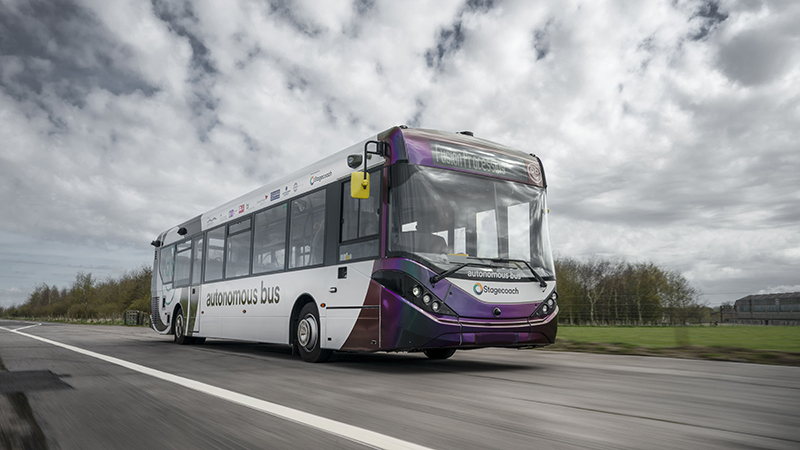
Towards a smart, sustainable and environmentally friendly transport system, Scottish authorities are preparing for their first experiment with self-driving buses. It will take place in a protected and controlled environment to study the possibility of wider deployment on public roads.
The concept of mobility as a service is expanding around the world, Which often incorporates the principles of automating booking and payment processes and moving towards operating vehicles with renewable energy. The sector is projected to be worth nearly $2 trillion by 2030.
In the UK, The government is looking to establish a state-of-the-art network to which all vehicles are connected by 2025. Autonomous vehicles will begin to be introduced into the transport system in 2021. For its part, The Scottish authorities see a modern transport system as a key element for sustainable economic growth. Especially in light of the environmental impact of traditional means of transportation and current safety rates, Despite being one of the highest in the world, it is not free from traffic accidents resulting from the dangerous behaviors of drivers. It kills dozens of people every year. Besides the loss of life and moral impact, Each incident incurred an estimated $2.5 million in economic losses.
Therefore, The Government Centre for Connected and Autonomous Vehicles and the UK Innovation Agency have jointly provided a grant of more than $5 million to Transport Scottish to pilot the UK’s first full-size self-driving bus. In cooperation with the company “Stage Coach”, The most prominent bus operator in the country.
The experience will include 5 single-story buses, It has a capacity of up to 36 passengers per trip, covering approximately 22 kilometers between the Fourth Road Bridge and Edinburgh. These buses are intended to be able to make a successful journey during which they interact safely with the rest of the traffic elements and cross intersections at speeds of approximately 80 kilometers per hour.
As expected, Responsibility for the legal frameworks governing emerging technologies is a highly sensitive issue, This calls for intensive work on the development of precise regulations governing the adoption of autonomous vehicles on the roads. For the same reason, This step was preceded by several preparatory stages, From the in-station bus experience, Virtualization to verify the performance of self-driving systems, It does not end with road testing after the authorities worked to adapt the road infrastructure and opened a special section to manage side emergency stations to serve buses during the trip. Moreover, The Transport Authority has made contact with various local administrative units for the use of the facilities and equipment of the National Traffic Control Center located on the southern part of the Fourth Road Bridge, The team also made the necessary preparations to respond immediately in the event of an incident.
To ensure that the process runs safely, The Transport Authority has chosen specific routes for buses equipped with high-tech sensors, The latter is integrated with technological software designed specifically to run buses without the need for the intervention of the driver, who will be present during the experiment as a safety agent to take over the drive in the event of any emergency. This software included adaptive cruise control, road monitoring systems, brake assist and more.
For innovation to best meet the needs of the population, They had to be involved in its design, Although they will not be part of the initial test, Around 500 users of the public transport network presented their visions for convenient, safe and reliable transportation. Based on these observations, DEWA has developed its vision for future vehicles, Vision did not dispense with the presence of a supervisor on the bus. To this end, The company will recruit more than 20 employees who are experts in managing these advanced vehicles to monitor the functioning of the systems. While they will oversee the technical side, The trip will be accompanied by another employee responsible for communicating with the passengers participating in the experience to collect their opinions, impressions and readiness to board absolutely self-driving buses. In the future, the technology reaches a stage that allows the driver to leave the cockpit and let the computer take over the operation.
Besides managing the process itself, The Transport Authority promised to share the experiment and disseminate information related to it, It is a trend supported by the government by hosting international events on this emerging technology, Such as the Conference on Connected and Autonomous Vehicles, Which brings together international experts who give presentations and lectures to introduce the field more, and to evaluate its latest developments, And discuss future experiences and research.
Once the trial is over, Partners will conduct a comprehensive assessment of the challenges and impacts they have faced. Contrary to expectations, This technology will not cause job cancellations, It will launch a new job market in the fields of data science and manufacturing, creating a social impact that complements its environmental and economic impacts.
In a typical working circumstance, Each bus can carry more than 10,000 passengers per week. Within shorter, more reliable journeys supported by efficient management of emergency side stations. In terms of public safety, It is estimated that this technology will prevent 25,000 accidents within a decade. 2,500 lives saved across the UK. The success of the program will also promote inclusive and equitable growth. It will contribute to reducing air pollution and congestion and establish smoother traffic.
In the long run, This shift will strengthen Scotland’s presence in the accelerating race for innovation and will be a testament to its openness to new experiences.
References:
https://www.transport.gov.scot/media/46708/a-cav-roadmap-for-scotland-final.pdf