
In a groundbreaking leap in assistive technology, Estonia-based 7Sense has developed the “Superbrain” device. This innovative tool enables the visually impaired to “see” through the sense of touch, utilizing advanced technologies that create a mental image of reality. This device sets a new standard in the field.
The visually impaired face significant daily challenges in a world heavily reliant on sight. This has driven hundreds of researchers, developers, and companies in the assistive technology market to create a multitude of products designed to address specific visual impairments. However, most of these solutions come with substantial drawbacks and limitations, such as interfering with other senses like hearing, which can alienate potential users. Or the challenges and constraints associated with more traditional methods like guide dogs, which are colour blind and can be costly to acquire and train. The cost is also a recurrent issue when considering canes and smart glasses. Meanwhile, reading software and text-to-speech programs face challenges related to multimedia content and cognitive load.
Today, the demand for versatile products that can be used in various situations without compromising other senses has become paramount. Recognizing this gap, 7Sense, an Estonian tech-innovation company, has focused on assisting the visually impaired and blind through the use of remote-control technology, artificial intelligence, and deep tech. The project has received joint funding from the European Union through the European Regional Development Fund and has partnered with numerous organizations, including the Estonian Blind Union, Technopol Business Park in Estonia, Eikholt Foundation, Nvidia, Tallinn Central Hospital, and other partners.
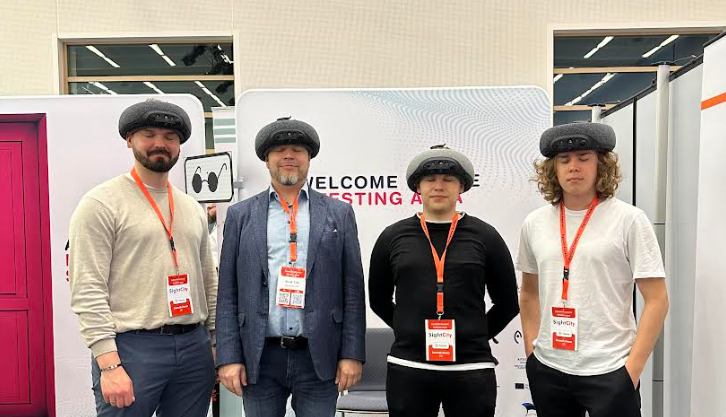
The “Superbrain” is an innovative device designed to emulate natural vision and adapt continuously to the needs of its users. Primarily aimed at visually impaired individuals across Europe, the Superbrain is a head-mounted device equipped with high-definition technology and an AI-powered scanning system that captures detailed images of the surrounding environment. The device seamlessly transitions from simply addressing visual impairment to providing the blind with a true visual experience. By transmitting real-time data to the user’s brain, the Superbrain allows them to process information in a way similar to sighted individuals. This is accomplished through numerous contact points that gently tap the user’s forehead, conveying a three-dimensional perception of their environment.
The “Superbrain” design is notable for its versatility, offering developers the flexibility to create tailored solutions and modifications to meet diverse user needs. This adaptability makes it suitable for a wide range of individuals with different visual impairments.
In simple terms, the device allows users to perceive their environment through their other senses, enabling them to sense objects, motion, speed, and distance, for example.
The development of the “Superbrain” was not without challenges, with the primary focus being the creation of a comfortable and user-friendly product. To address this, the company incorporated high-quality, reinforced, flexible fabric into the device’s exterior and used hypoallergenic materials at all points of contact with the user’s skin, ensuring both durability and comfort.
The team had to ensure that their innovation did not interfere with other essential senses, such as hearing, which are crucial for users. While the device was designed to assist visually impaired individuals in accessing visual input through tactile perception, it relied on users’ ability to interpret this input. However, these capabilities are not universally available, and the team continues to explore ways to make the product accessible to individuals with heightened sensitivity to stimuli, such as those with autism. Developing solutions for such groups will remain an ongoing challenge and motivation.
Notably, the company adopted a unique approach to product development by creating a platform for developers to share specialized problems and propose solutions. This has made their product one of the most versatile on the market, particularly as they explore new applications and use cases.
Most importantly, the development and deployment of the “Superbrain” device marked a significant milestone in assistive technology, offering an unprecedented experience for the visually impaired. It provided a new level of independence and interaction with the environment, previously unimaginable.
Beyond its impact on individual users, the device stands as a testament to the power of innovation and technology’s potential to transform lives.
References: