

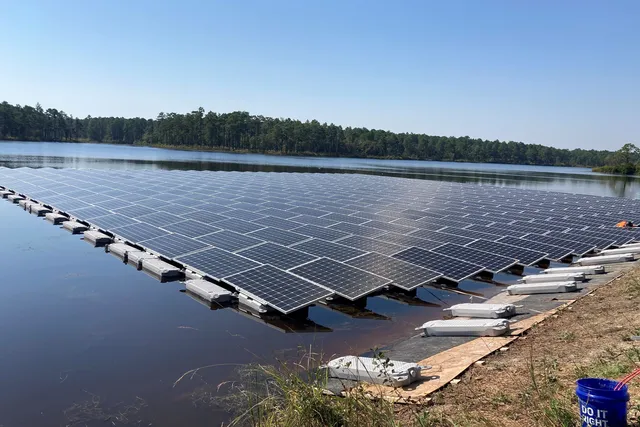
Due to exclusive land use, energy distribution and heat dispersion, the municipality of Cohoes, a small city in Albany, New York, has realised that its conventional solar plants will come to a standstill and floating solar is a solution to many problems. Hence, the city has embarked on an innovative pilot project that has made a big splash in the US.
With the approaching depletion of fossil fuels in many countries and the exacerbation of environmental concerns, the world is turning more and more to alternative energy resources. While solar appears to be a major energy source that humanity has high hopes for, especially that it’s the cheapest among renewable electricity sources, its plants are less energy-dense, meaning they produce less energy per unit volume and require more land, compared to fossil fuels for instance. Producing a single watt of electricity in a traditional solar farm requires much more land than that required for producing the same watt from fossil fuels, and natural gas is about 80 times more energy dense than solar.
In light of this paradox, and the fact that two-thirds of our planet is covered by water, ‘floatovoltaics’ have been a global trend. They are mounted on structures that float on bodies of water, such as lakes, rivers, beach ponds, reservoirs, dams, or even offshore waters. In the US particularly, floating solar has become an increasingly popular option. It has been extensively used by the US military, which has deployed a floating solar array in North Carolina, home of the country’s largest domestic military base. Yet, ‘floatovoltaics’ have not yet grabbed mainstream attention in the US, making up only 2 percent of the country’s solar installations.
The extensive use of land, however, is a big disadvantage for Cohoes, whose area is less than 11 square kilometres. With a population of 18,000 people, mostly workers, Cohoes uses solar energy harvested from conventional photovoltaic cells across its limited land. Residents perceive the vast arrays of solar panels as a pest that gnaws at their arable land and distorts its natural beauty, while decreasing property prices.
Hence, it was logical for Cohoes municipality to consider floatovoltaics, which can solve several of the problems associated with conventional solar energy: exclusive land use, energy distribution, and heat dispersion. The promising tech may also help with hydrological regulation in canals, reservoirs, and draught-threatened natural bodies of water. The city studied the feasibility of installing a floating solar array on its water reservoir, based on a National Renewable Energy Laboratory (NREL) report.
The first US city to take such a step, Cohoes has faith in its 3.2 MWdc Floating Solar demonstration project, which will cost of $5.9 million. Seeking funding, the city has explained that providing grants to municipalities — as an alternative option to current tax credits for private investments — for floating solar installations would incentivise municipalities to invest in their own energy infrastructure in a sustainable way.
The project, to be launched in 2024/2025, has gained traction, both technology and funding-wise, and inspired a nationwide movement to introduce legislation for federal support of researching and launching the arrays across the nation’s 24,000 reservoirs, paving the way for other municipalities to follow suit.
Estimated to produce over four million KWHrs in year one, the installation will be located in the city’s water filtration plant, a secured site of 14 acres, with a water tank of 10 acres, which is more than enough space. Studies have shown that 60% of the Cohoes reservoir’s capacity will be sufficient to generate 100% of the municipal facilities’ energy demand, leaving 40% to address additional economic/environmental justice issues within the city’s community.
Despite the enthusiasm, floating solar comes with drawbacks. For plants intended to last up to 25 to 30 years, equipment corrosion can reduce their durability and require more maintenance, especially in waters with high salt levels. Floatovoltaics are also more capital intensive, as their initial installation cost rises between 10 and 15 percent compared to their ground counterparts. The panels essentially sit on a sort of raft that’s tethered to the bottom of the body of water. Moreover, floating solar still suffers from many of the intermittency issues that land installations suffer; energy only when the sun is out and disparate timing in stressing power grids.
Nevertheless, compared to land-based photovoltaics, floating solar may be more affordable in the long run and more economically advantageous over time. Floatovoltaics come with unique benefits too: they reduce the need for land, and under certain conditions, produce more energy than conventional solar when exposed to the same amount of sunlight, according to studies.
References:
https://www.theverge.com/2022/6/14/23167441/us-army-floating-solar-power-plant-floatovoltaics
https://www.ci.cohoes.ny.us/523/Building-Floating-Solar-in-Cohoes
https://www.timesunion.com/news/article/Cohoes-floating-solar-array-plan-inspires-federal-17627636.php
https://www.nrel.gov/news/program/2022/small-city-sets-example-for-floating-solar-empowered-by-nrel-data-set.html
https://www.ifc.org/wps/wcm/connect/6ef92aa8-bf29-4c43-8edc-a0f7555e6a5d/IFC-EnergyNotes-FloatingSolar_WEB.pdf?MOD=AJPERES&CVID=n8KDCtS#:~:text=Floating%20systems%20present%20specific%20challenges,as%20high%20winds%20and%20waves