
To maintain its position as a global transit transport hub, Singapore has embarked on the construction of a new port with more space and advanced technical equipment that will fulfill the country’s ambition to be the largest shipping point ever.
The economies of countries vary according to their geography, Island countries are often characterized by smaller economies and relatively isolated from global systems. They are governed by economic standards that differ from their land-boundary counterparts.
As an island nation, Since the eighties, Singapore has been able to build international economic links, Benefiting from the dependence of 80% of global trade on maritime navigation, It is connected to 600 ports in more than 120 countries, It receives more than 130,000 ships every year. It connects – by its location at the Strait of Malacca – the industrialized Asian countries with those consuming in Europe, This has established its position as a major transit transport location, It is the process of stopping ships at the distribution port to unload goods that will be carried by other ships to their destinations. Given this importance, Even the effects of the COVID-19 pandemic have been less severe on Singapore’s main port. But it posed many challenges to global trade in general. Ports are the most prominent points that regulate an activity worth more than $ 22 trillion annually. The pandemic has changed the nature of global supply chains and led the traditional shipping system to collapse. It is no longer possible to wait for old goods to run out to supply new ones, Asian exporters are struggling to serve their Western customers. A reality exacerbated by the Russian-Ukrainian war, Thus the scene had to be repainted, Addressing deficiencies in capacity, speed, efficiency and container backlog due to difficult paperwork, weak manpower and truck shortages.
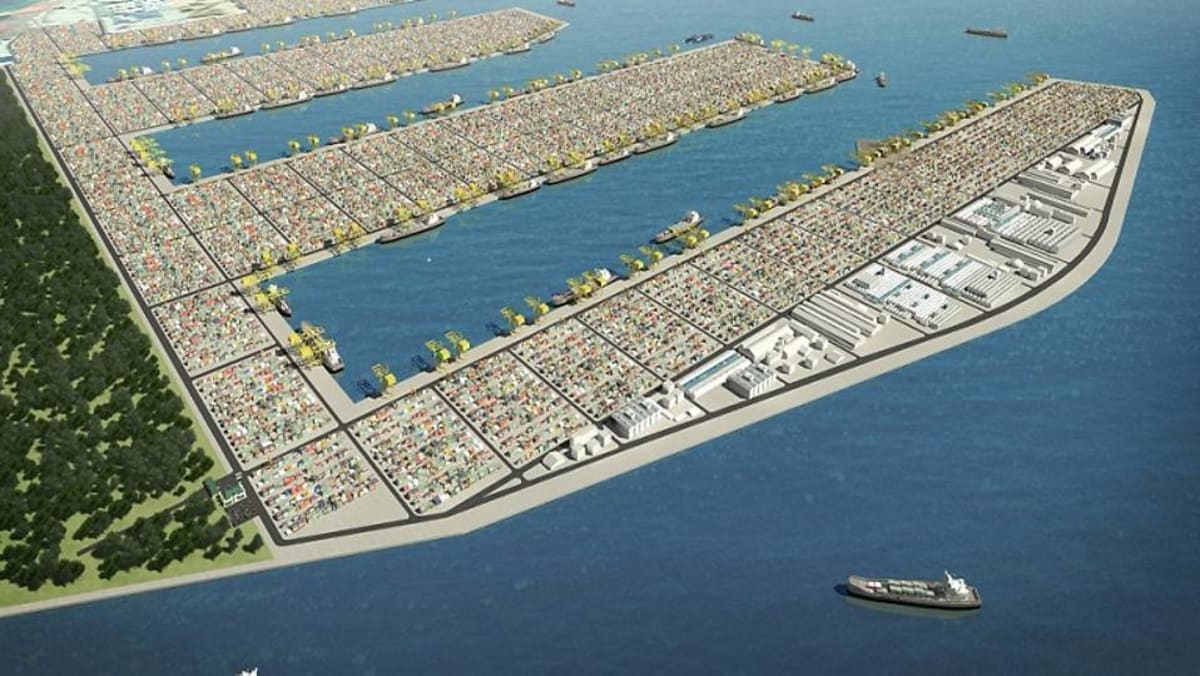
To this end, The Singapore government has committed US$14 billion to launch the world’s largest automated port in 2040. The port of “Tawas” will be built on twice the area of the existing port today, It covers land that the government has been reclaiming since 2013. It will include technologies such as drones, self-driving electric vehicles, and automated pavement functions, This is to double the work of the port, which handles 45 million equivalent units of twenty feet annually, That’s 45 million containers with a length of about 3 and a half meters, and a width of about 7 meters, And the height ranges from one and a half to 3 meters.
Technically The government is moving to improve the port’s ability to monitor and coordinate operations occurring at sea. Several innovations are currently being tested for this purpose, Such as a next-generation system that manages ship traffic by predicting congestion points, or the maritime “single window” that simplifies clearance procedures and allows them to be carried out electronically, or the “timely planning and coordination system” that regulates the docking and rotation of ships in preparation for sailing, or drones that make deliveries between shore and ship and assist security crews in inspections, When the port receives a vessel with a gross tonnage weighing 300 tons and above, A licensed official goes to it on board a small boat, He goes up to guide the captain to move safely through Singaporean waters.
In the same vein, The Information Applications Development Authority is working with the Maritime and Ports Authority to provide all its facilities with 5G coverage by 2025. To direct incoming ships to port remotely via live audio and video broadcast, Knowing its cargo and conducting emergency inspections and maintenance, and giving medical instructions in the absence of medical staff on board,
But the most important point will be the use of autonomous vehicles that will transport containers between yards and docks where ships await them. and a driver’s allowance for each truck, An employee will drive one truck equipped with sensors and wireless communication technologies to steer a convoy of other trucks in and out of the port. This experiment is intended to be integrated with information systems that allow truck tracking and reporting of any increases in demand to all parts of the supply chain.
By 2027, The new port will integrate Tanjung Bagar, Kepil and Barani stations. It will include Pasir Pangang station in 2040.
But Singapore’s ambition will undoubtedly face significant challenges. The first is the competition of neighboring countries such as China, which has been working for years to increase the capacity of its ports. Which is unique to 7 of the 10 largest container ports in the world, Its railway network is developing its service and there are cheaper alternatives to air transport.
The challenge of the times remains climate change, which raises sea levels and poses a long-term existential challenge. The authorities decided that the new port will rise more than 5 meters above sea level to ensure its protection against any future threats.
By enabling hot-swap containers on site, The port will handle 65 million twenty-foot equivalent units annually, As for the integration of the different stations, The work will be unified into a more organized form, Trucks will not have to cross the congestion of the city to transport goods from one station to another, This will shorten the waiting hours for loading goods.
Autonomous vehicles will help reduce manual labor, It will also work to ease its burden, and the completion of more dangerous tasks, Increase oversight to detect potential threats. The adoption of the single window system will make Singapore one of the seven countries that accept electronic shipping documents that facilitate work and mitigate the environmental impact of paperwork. As for the coverage of the fifth generation, It will contribute to enhanced safety, service efficiency and resource utilization, reduced response time and improved performance of ships arriving at and departing from the port of Singapore.
References:
- https://www.smartcitiesworld.net/4g-and-5g/singapore-to-create-testbed-for-maritime-5g-use-cases
- https://www.ship-technology.com/analysis/why-is-singapore-port-so-successful/
- https://govinsider.asia/security/exclusive-singapore-wants-robots-to-run-its-ports/ https://www.mpa.gov.sg/docs/mpalibraries/mpa-documents-files/comms-and-community/singapore-maritime-gallery/row-232-theme-2.pdf#:~:text=As%20a%20premier 20Global 20Hub 20Port%20Singapore%20is 20linked 20to,trade 20comes 20by%20the%%20Global%%20Port%%20linked%%20comes%
- https://www.bloomberg.com/news/articles/2022-06-28/singapore-mega-port-could-offer-solutions-to-supply-chain-crisis
- https://www.channelnewsasia.com/commentary/tuas-mega-maritime-port-challenges-singapore-shipping-hub-877421
- https://www.eco-business.com/news/as-sea-levels-rise-can-singapore-ratchet-up-the-ambition-of-its-climate-targets/