
To strengthen the resilience of Singaporean society to flash floods, The National Water Authority is developing several technological tools to predict these phenomena and contain their effects.
Statistics show that floods are the most common natural disasters. Due to the multiplicity and diversity of its causes that affect many lands around the world, However, it is particularly frequent in coastal and tropical areas.
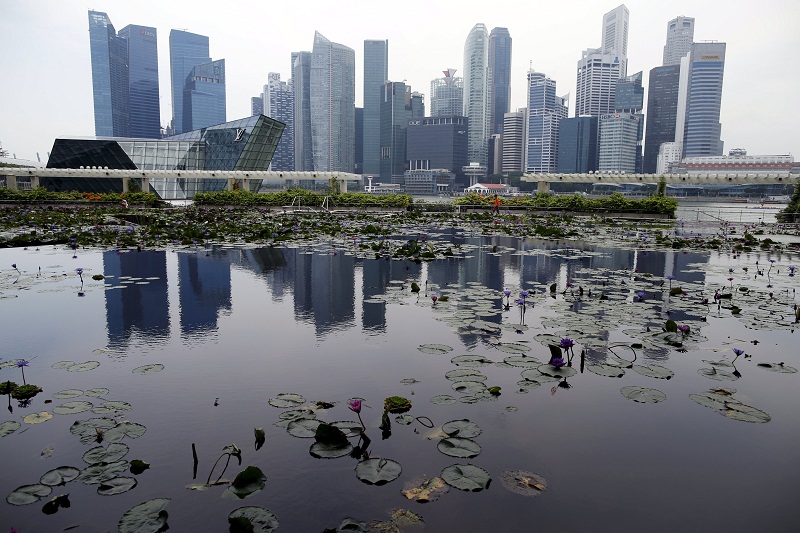
In Singapore, The height of about 30% of its territory does not exceed five meters above sea level only, This rate is increasing according to the Singapore Meteorological Service’s 2019 climate assessment report. The capital is also a tropical coastal strip, This exposes it to severe weather conditions such as severe storms and high rainfall rates, which increases the possibility of flooding. A reality exacerbated by climate change with the melting of ice sheets, rising ocean temperatures and erratic rainfall, All of this has made floods more severe and frequent than unpredictable. Although it usually takes half an hour to begin to recede and pour into the banks that the government has built over the years, The option of expanding or deepening banks remains a high-cost and impractical. In addition to the direct effects of the floods on loss of life and property, They destroy agricultural crops, lose livestock and disrupt roads and businesses.
To adopt more efficient strategies, Singapore’s National Water Authority is increasing its reliance on technology to prevent and contain flood impacts, In partnership with the National University of Singapore and the Institute of Aquatic Informatics.
First thing DEWA has developed a smart monitoring system that transmits live data from all over the city and from various sources such as sensors that measure water levels in reservoirs and drains. or that track rainfall rates, Or cameras of video surveillance systems.
All of this data is provided to a dashboard operated by the command center staff. And through them, They follow flood-prone areas, They decide which field teams should be sent to an area following a flood. To this end, DEWA has hired 13 new vehicles to respond quickly to sudden cases. When a flood occurs somewhere, Field teams should arrive as soon as possible to create portable barriers to block damaged roads; divert traffic through alternative routes, and provide assistance to stranded pedestrians. Response vehicles were also equipped with GPS tracking devices connected to surveillance cameras. Which allows direct monitoring of the flood flow.
The authority chose to invest in radar technology to increase the accuracy of rainfall forecasts, It has 6 radars that monitor rainfall in a 60-kilometer radius in the northern, eastern and western parts of Singapore. Through the data collected by these devices, The country’s first computer modeling system is fed, Which will be developed over 4 years at a cost of $ 13.4 million to analyze data and issue forecasts about half an hour before the start of the rains, This is done by tracking temperatures and the formation of rain clouds and their speed of movement. The coastal model of the system will simulate possible changes to waves and winds near the shore, Its internal counterpart will address floods caused by rain or changing sea levels. With this, The two models assess risk according to different scenarios.
In addition, The Authority has erected so-called automatic barriers, which automatically drops below ground level as the water level recedes, Without the need for any human or mechanical intervention. The first experience of these barriers was in 2021, Where it was installed at the entrance to one of the residential units. DEWA has recently added a new device called “Flood Gate”. It is made of high-strength steel frames and coated with a waterproof rubber coating, What distinguishes it is its scalability in the event of a sudden flood and the possibility of installing it at the entrances to residential, commercial and industrial buildings. Whereas, the length of these devices is 0.68 meters, The technical team has worked to provide various options in terms of width ranging from 0.77 to 1.52 meters, These devices can also be linked together according to the dimensions of the place to be protected, Whether it is a building, storefront or any other facility.
To increase coordination with the local population, The Authority is working on developing an early warning system to inform citizens of possible flood sites through multiple channels such as text messages. Social media pages and channels and an application specialized in information related to the environment.
Of course, The government will continue to improve sanitation works, It has allocated $1.63 billion for this purpose over the next five years.
DEWA will benefit from advanced modeling techniques to build its expertise, Promote accuracy and speed in flood prediction and response, Evaluate the effectiveness of the proposed infrastructure, Improved operations management, Monitor methodological challenges and impacts.
In turn, Monitoring systems enable better fleet management, Response teams are directed to affected points easily and in a timely manner.
According to the National Water Authority, Automated flood barriers have proven to be an effective, viable and cost-effective solution. Today, The Singaporean authorities encourage building owners to install barriers as a precautionary measure to protect their property. In particular given the flexibility offered by the new “flood gates” and the first-hand information provided by communication channels, Which attracted more than 10,000 subscribers during the first five days of its launch.
Following the government’s efforts over five decades, The risk of flooding in Singapore has decreased from 3,200 hectares in the seventies to 28 hectares. This endeavor continues to protect Singaporeans from the risks of natural disasters.
References:
- https://govinsider.asia/vision/how-real-time-data-is-keeping-singapores-floods-at-bay-lee-cai-jie-pub/
- https://www.straitstimes.com/singapore/environment/pub-starts-work-on-computer-modelling-system-to-prepare-for-floods-and-rising
- https://www.straitstimes.com/singapore/pub-trials-new-flood-protection-barrier-in-preparation-for-monsoon-season