

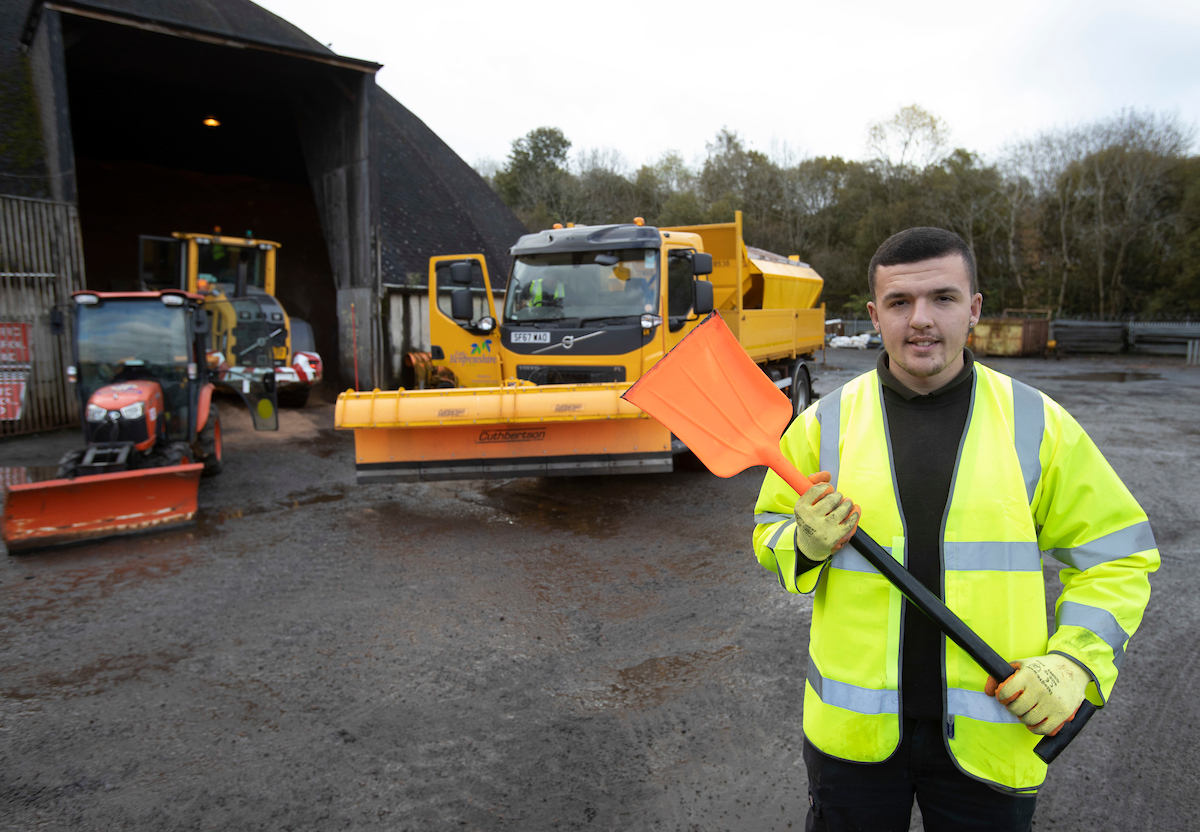
Road safety and user safety are a priority for the Scottish Councils, Especially in light of the harsh weather conditions that the country witnesses throughout the winter months. Supported by the Scottish Innovation Centre, The East Renfrewshire District Council is piloting a system that uses road-based sensors to monitor temperatures and send snow and frost removal service vehicles. As part of a broader project that aims to improve road efficiency and reduce the number of traffic accidents.
The frost phenomenon is a climatic phenomenon classified as hydrometeoric, It is a condition caused by temperatures dropping to zero degrees Celsius or below. The frost causes significant damage to vegetation and obstructs traffic, causing thousands of accidents annually. In order to address the frost phenomenon, Governments of countries with cold climates are making great efforts to identify the best means and priorities in the process of reducing the effects of frost, Based on forecasts issued by forecast and meteorological centers.
In Scotland, Roads are usually exposed to frost, which imposes many risks on transport such as slips and traffic accidents and causes chaos on the roads, The frost and bad weather of the winter of 2011, for example, cost several billion pounds. The eastern Renfrewshire region is characterized by low surface temperatures and easy frost formation on the roads after snowfall. This requires the competent authorities to monitor continuously to know the severity of frost, the time and place of its occurrence and formation, As well as better mechanisms for reporting where it forms and arranging its removals.
To work towards a better level of road management, The Eastern Renfrewshire Council launched the Smart Winter Services Project, which is the first of its kind in Scotland. The project was supported by the Scottish Innovation Centre (CENSIS). His idea crystallized after it was presented as one of the outputs of a workshop held by the non-profit centre with the Digital Office of the Scottish Local Government. The support provided by the Innovation Center was to provide the team with sensors, imaging and Internet of Things technologies, The Innovation Center harnessed the technical expertise of its staff to select the right sensors and develop the IoT infrastructure to facilitate the success of the experiment.
Accordingly, Sensors have been installed on the outskirts of Barrhead to measure the temperature on the roads. It continuously monitors and measures temperatures, It is then converted into analyzable data to study the patterns and conditions of frost formation. Through two different communication networks that link the system together, Real-time data is sent to East Renfrewshire District Council for review, review and analysis along with available information on the current weather condition. which are provided by the local authorities responsible for weather forecasts. Besides, The Council is moving to enter this data into the mapping program to add the feature of identifying the roads most affected by frost and extreme weather conditions. The accumulation of data over the coming years is expected to enable technical teams to create a predictive model that is continuously fed with updated data.
Although the sensor system is still a prototype and is nothing more than a simple application for the Internet of Things, It adopts low-cost technology, It has been designed to be effective in this respect, so as to enable its wide application, Its system also does not require any additions to the infrastructure, Not even plugged into a power source. The information obtained by the team during the trial period will be useful for years to come in improving the delivery of snow removal services.
Despite the efforts of local councils to combat frost through traditional means such as increasing rock salt reserves, Frost remains a challenge that recurs year after year in a country characterized by cold winters and high snow rates. It is also difficult for local authorities to operate snow removal vehicles to cover all the country’s roads simultaneously. Sometimes it happens that snow accumulates and frosts intensify to the point that the vehicles themselves become almost impossible to reach.
Through the regular and continuous data provided by sensors, Road crews can target resources in areas of greatest need and provide snow removal services smarter, safer and more easily. In addition, The Council can use the predictive model to increase road safety and reduce mobility problems by anticipating and avoiding them.
If the pilot scheme for this project is successful, which will continue throughout the winter, The government seeks to spread it throughout Scotland, As part of a move to make the country’s roads safer, While enhancing dialogue and sharing experiences in public services and increasing the use of technology in the future design of government services.
References:
- https://www.ukauthority.com/articles/east-renfrewshire-council-begins-smart-gritting-trial/
- https://www.heraldscotland.com/news/18958365.barrhead-centre-road-sensors-plan-cut-danger-ice-snow-scots-highways/