
To take advantage of the huge potential of the North Sea winds, The Belgian government has started building the first project of its kind in Europe and globally, It is an artificial island for generating clean energy and sharing it with neighboring countries.
The COVID-19 pandemic has exposed many gaps and vulnerabilities, Even in the most successful and efficient governments, In countries known to host the world’s best living standards, Like European countries that have witnessed successive crises of economic decline and high unemployment rates, In addition to the great pressure that the health systems are under under . All this at a time when these countries are striving to meet their commitments on climate change.
The first step taken by the European Commission in its awakening from the pandemic was to provide support to Member States to finance recovery plans, build resilience, achieve green transition and digitalization. Belgium’s share amounted to 5.9 billion euros, Distributed over 165 investments and 35 reform processes, Half of it focuses on climate.
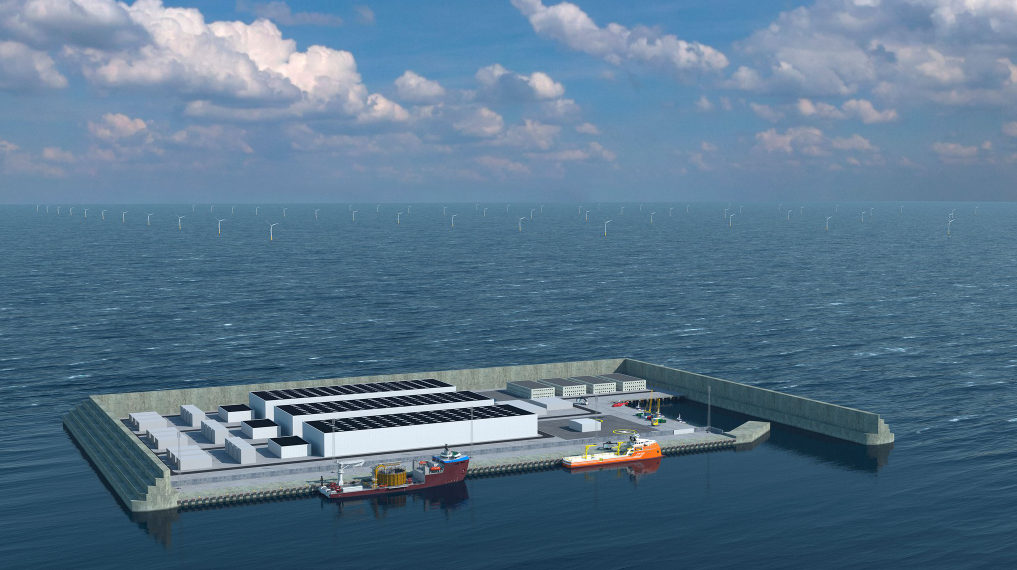
As part of a series of investments aimed at transforming the North Sea into a large green energy plant, With funding of 100 million euros, The State Power Transmission Operator of Belgium has completed, Which is known as the “Elijah” group, Plan for the construction of the first artificial energy island, It will be named “Princess Elizabeth Island” after the young heiress to the Belgian throne.
The island is located in the North Sea, 45 kilometers off the coast, It will cover approximately 5 hectares. This strategic location is called the “Second Belgian Offshore Wind Zone”, It is characterized by strong permanent winds and low depth, It is also close to industrial areas that consume a lot of energy.
On the island, A high-voltage onshore grid will be built to distribute electricity, It will have a maximum capacity of 3.5 GW, Part of it will be transported to land via special direct current cables extending for 60 kilometers.
To build the island, The geotechnical team will begin by creating a ring of concrete structures called caissons on the seabed, to be filled with sand, They are chambers that sink into the sea and allow water to be thrown out of it, They are used in the construction of dams, bridges and ship repair.
on the surface, Electrical infrastructure will be laid and AC substations will be built, In addition to a small port and a helipad that will carry maintenance teams to and from the island. The island will also be surrounded by a high wall that protects it from strong waves, rain and flooding.
These installations will collect electricity generated from wind energy, Then you will convert the voltage levels to transmit them with minimal network losses, Electricity generated from multiple projects in the North Sea will gather at a central point before being transported to the mainland. The grid will also provide the option of converting electricity into hydrogen and will be equipped with capture and storage technologies.
In the next stage, Power lines will be extended that will make the island a hub for hybrid power connectors between Belgium and both the UK and Denmark. These connectors are cables that are mainly used to transport electricity and gas between one country and another.
The federal government plays a key role in the development of the wind energy system. Having set a timetable for the completion of the Princess Elizabeth Island project, Where work is currently underway to prepare the tender for the implementation of the project, study the environmental impact and issue permits, This is to be accomplished by the end of 2023. The following year, Construction work, which will last for two years, will begin, Then the construction and operation of the electrical infrastructure begins, which will run until 2030.
It should be noted that this type of project is receiving increasing attention in multiple European countries such as the Netherlands, Germany and Denmark. The latter hosted a meeting of heads of government of North Sea countries where they signed a cooperation agreement aimed at generating at least 65 kilowatts of wind power by 2030. This figure was then raised to 150 MW over the following 20 years.
To play its full role in this context, Belgium has established 8 offshore wind projects, Where the demand for them grew by 13.3%, It now generates 2.262 megawatts, To be integrated with 2408 MW of terrestrial wind systems.
Although the primary objective of these projects is to protect the environment, The Nature and Environment Foundation has expressed concerns that these artificial islands with their sand will cause disruption to ecosystems. It may affect marine life and disrupt natural processes with leaks, lighting and noise pollution. Therefore, Elia Group has made redoubled efforts to contain environmental impacts, It established a team of experts to explore ways to create new habitats around the island and within it. This is called universal natural design solutions.
On the other side, Many components of this environment may pose a danger to cables and pipes stretching for thousands of kilometers, The Belgian government plans to secure all these cables by enacting laws, using surveillance systems and drones, tracking foreign boats entering territorial waters and conducting regular safety checks.
Besides clean energy generation, This island will be the first link in the marine energy chain that European countries aspire to establish. The inter-power connectors will also perform a dual function, It will allow Belgium to benefit from offshore wind farms built by other countries with a larger offshore area, This means facilitating the international exchange of electricity and enhancing energy security, This is an important step towards carbon neutrality.
References:
https://www.elia.be/en/infrastructure-and-projects/infrastructure-projects/princess-elisabeth-island