
To protect the environment, the Korean Busan Port Authority (BPA) has begun implementing two innovative projects utilising the features of sea port; one is ‘piezoelectric power generation system’ and the other is ‘construction wastes recycling project’. Both projects have been assessed not only to contribute to the improvement of environment, but also, to reduce construction cost.
Seaports play a role of utmost importance to countries as they are the primary engine for exports and imports, and the main controller of the global economy. There are even countries that depend on a large part of their national output on their ports, which may reach imaginary levels.
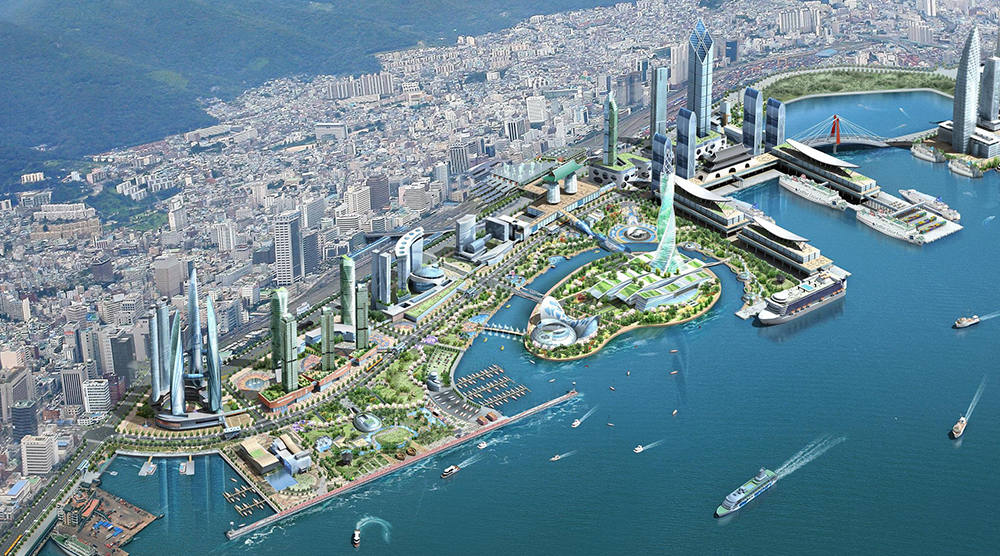
Busan Port is the world’s fifth busiest container port in North East Asia. The port has a 26.8km quay wall that allows it to berth 169 vessels simultaneously and has four modern, fully equipped ports, an international passenger terminal, and six container terminals. Hence, the port earned the attention of the authorities, so it was provided with the latest technologies in ports and shipping, as well as the most innovative solutions to various challenges were developed.
Today, like other major vital facilities, Busan Port faces a major challenge related to the South Korean government’s fulfilment of its commitments towards climate change. Busan Port Authority, which is managing and operating the port, must find effective ways to reduce energy consumption and achieve sustainability amid growing concerns about pollution and the exhaustion of resources.
In the process, the BPA has conducted two eco-friendly innovative projects, one is the adoption of piezoelectric power generation system and the other is the recycling of construction wastes.
The Ministry of SMEs and Start-ups financed the development and demonstration of the ‘piezoelectric power generation system’, which uses harvesting modules to convert and store electric energy from the pressure and vibrational loads imposed by wheels of trucks passing above the system before the gate of container terminals, and convert such pressure and vibration generated by container trucks into electricity.
To develop the system and conduct tests, the authority cooperated with technology developers and port operators in the private sector to rent sites and vehicles necessary for field tests, where a team of experts were devoted to developing a prototype of the system in efforts that took several months before the pilot project saw the light in 2022. The pilot project for testing the durability of the module and the amount check of generated electric power was completed as planned.
It is worth noting that the piezoelectric energy systems are distinct from other renewable energy systems; they are not affected by changing weather conditions, and are not hindered by the absence of the sun or the cessation of wind blowing, but rather continue to generate electricity 24 hours a day. This is what makes them an ideal investment for Busan port congestion.
The BPA chose to generate electricity using the weight of container trucks, hence a piezoelectric power generation system is developed and installed at the gate of a terminal port in Busan, and would use heavy container trucks weighing up to 40 tons to produce efficient renewable energy just by passing through a gate.
The second project is the ‘construction wastes recycling project’, which had started from the idea that a huge amount of aggregate is, in general, needed for port construction projects, and the share of construction waste in the total wastes is very high as much as 45%. Wasted aggregate, which is reprocessed to a concrete following the high-quality standard, is planned to be used in the ongoing six construction projects in the Busan New Port, port hinterlands, and port redevelopment sites.
A large part of these standards is determined by the guide issued by BPA, which contains comprehensive standards for the usage of recycled concrete and aggregates. It is not legally binding, but it aims to educate interested citizens and companies.
However, these standards were not enough to eliminate concerns about recycled materials, hence BPA is trying to spread awareness through various means such as press releases, educational programs for concerned contractors, in addition to social media platforms to educate the local community about the quality of recycled products and their environmental and economic impact.
The piezoelectric power generation system is expected to generate 45 MWh/a year, which is the amount equivalent to the power use of 125,000 households in Busan every year. If the modules are to be installed at all the 47 terminal gates, it will reduce carbon dioxide emissions by more than 900,000 tons annually. BPA will donate part of the profit from the power generation to nearby fishing villages and local communities.
Since the launch of the ‘construction wastes recycling project’, BPA has used 160,000 cube meters of circulated aggregate and more than 15,000 cube meters of circulated asphalt concrete. This resulted in a budget saving of more than $3 million. As part of a national initiative, BPA intends to share the results of its experience with the rest of the Korean and international ports, as the two projects will open new markets and many job opportunities, and provide clean alternatives to vital operations that the port witnesses every day.
References:
https://www.ajudaily.com/view/20211119152652445