

The public pay phone has been displaced by mobile phones. In the United States alone, the number of public payphones decreased by 75% in 2014 compared to 2000. This was not good news to municipal offices who benefited from the proceeds of ads displayed inside booths. Measures had to be taken to find an alternative. Indeed, NYC Mayor’s Office organized several competitions to find an alternative to pay phones that were becoming less popular and generating less revenue.
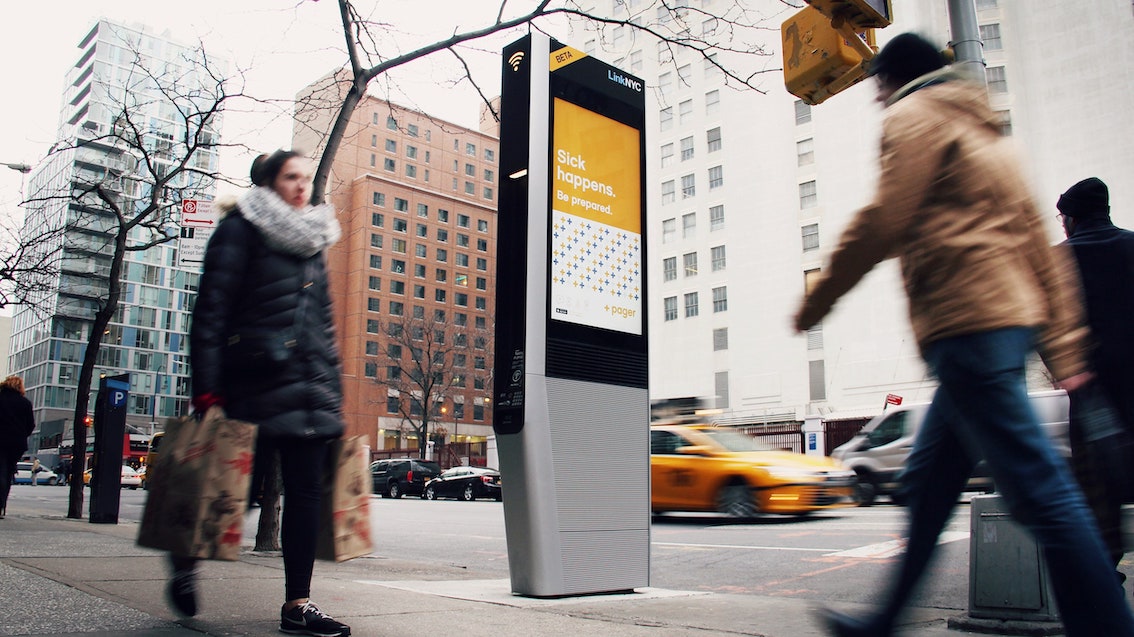
One idea put to the table was LinkNYC. This innovation saved the government the complexities and efforts of removing unused pay phones. In 2014, Mayor Bill de Blasio, in collaboration with CityBridge and the Department of Information Technology and Telecommunications, announced that nearly 12,000 pay phone booths would be reused and transformed into kiosks with free Wi-Fi and a 55-inch screen. The pilot phase of the project began by equipping 10 booths in Manhattan, Brooklyn, and Queens and replacing them with kiosks offering free Wi-Fi.
The main objective of the USD 200-million project was to facilitate communication between millions of citizens by providing free Wi-Fi within a range of 150 feet. On another note, the project resulted in the creation of about 150 full-time jobs in the manufacturing, technology, and advertising sectors. The project is expected to raise the municipality’s advertising revenues to USD 500 million over the twelve-year contract with CityBridge. These booths are perceived as digital advertising platforms where local and national companies can place their marketing ads.
To achieve its intended purpose, LinkNYC booths have been equipped with fiber optic cables to provide residents of New York with free high-speed Wi-Fi that is far better than any other open network. These booths were distributed across five boroughs, each providing access to up to 265 users at the same time. In the pilot phase, the project inspires to install over 7,500 booths during the next eight years until 2026.
LinkNYC booths are expected to achieve a significant turnout since they offer a range of uses that combine the advantages of public pay phones and mobile phones, such as the ability to make international and free calls within the United States, in addition to the possibility of connecting to a secure, free, and high-speed Wi-Fi network. Moreover, these booths can be used to make free 911 emergency calls. These booths allow people to learn about city services, check maps, and look for directions by using touchscreen tablets. In order to meet the requirements of all segments of society, locations have been carefully chosen to facilitate access for people of determination. Furthermore, each booth contains free USB ports to charge various devices.
The booths are equipped with multi-use screens that attract residents by displaying important ads and information, such as bus arrival times and data related to government services like dates of registration in healthcare programs and other useful data. These screens also show news headlines, comics, weather updates, and alerts from the Office of Emergency Management. Along with public service announcements, small companies can publish their ads in designated booths for free.
LinkNYC booths made tangible achievements from January 2017 to February 2018, whether in terms of the number of fully activated booths or installed booths, in addition to the number of participants that surpassed 3.5 million in March 2018. Currently, 1,772 booths have been activated in five New York City boroughs, mostly concentrated in Manhattan and the surrounding neighborhoods. In 2016, LinkNYC booths hit three major milestones: one billion calls, five million users, and half a million calls a month. By the end of the same year, booth users had consumed more than 3.6 million gigabytes of data, equivalent to playing over 580 million songs and streaming 3 million hours of video. LinkNYC yielded high returns upon its launch compared to the current and projected ones, as it raised a total of USD 42.5 million for the city within two years of its launch.
On another note, New York’s Department of Information Technology and Telecommunications is collaborating with the Mayor’s Office for People with Disabilities to provide free calls to the deaf through a video-relay service and connect users with American Sign Language interpreters. In April 2019, LinkNYC partnered with the New York City Council to present Participatory Budgeting in NYC, which allows residents from the age of 11 to vote on how the city can spend its USD 40 million budget via tablets installed inside the booths.