
To promote sustainable agricultural livelihoods, the government of the Indian state of Kerala has launched an initiative called the “Food Platform.” This initiative aims to establish a network of cooperatives across various sectors, including agriculture, dairy products, and organic food distribution, in order to address the challenges faced by the agricultural system and enhance its resilience, transparency, and fairness.
For centuries, agriculture has been the backbone of human civilization, nourishing people, providing employment, and supporting communities. However, the rapid evolution of the world presents unprecedented challenges to the delicate balance of this ancient practice.
In India, for example, factors such as fragmented landholdings and the continuous depletion of resources create a precarious situation. Some states, including Kerala, have begun to recognize this danger, as the agricultural sector’s contribution to the state’s GDP is declining. Farmers lack bargaining power regarding the value of their work because their landholdings are small and scattered, leaving them without an effective collective voice in the market and no significant or widespread economic patterns. Additionally, Kerala’s agricultural system suffers from a lack of transparency and inconsistency in the pricing of organic products, making prices unfair in most cases, especially given the multiple stages of the supply chain, intermediaries, and processes involved.
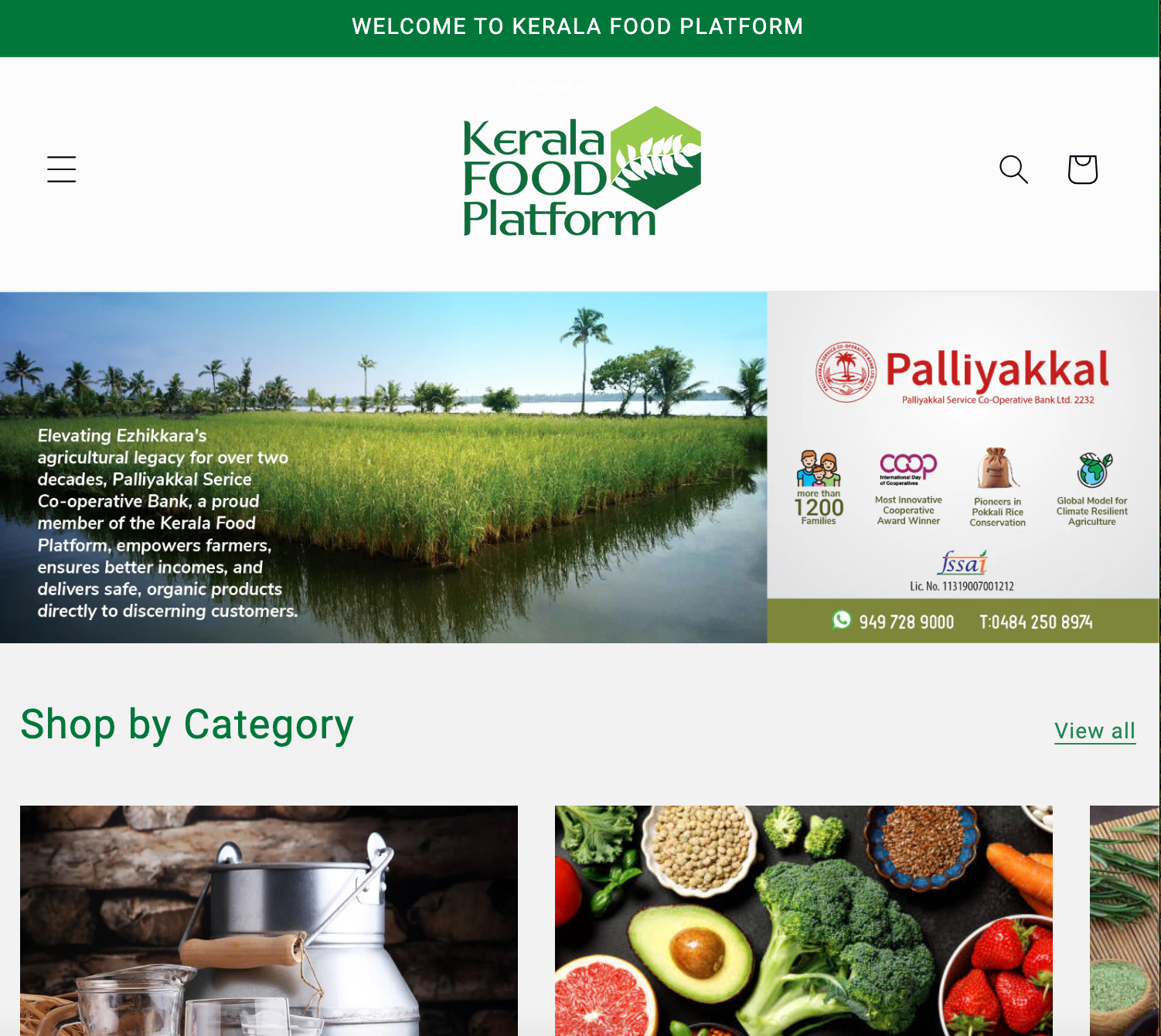
To address these issues, the Kerala State Council for Development and Innovation has partnered with the “Paliyakkal” Cooperative Bank to launch a pilot project that offers a solution: the Kerala Food Platform. Currently operational in the ” Ezhikkara” region, this platform serves as a unified digital infrastructure that is customizable and adaptable for both local and global development. It provides a comprehensive set of tools and services necessary for market connectivity and is capable of adapting to local agricultural ecosystems. The platform connects all stakeholders in the agricultural value chain, including farmers, advisory and extension centres, credit and logistics service providers, and others.
The bank has established self-help groups across seven sectors: fruit and vegetable production, dairy products, poultry, medicinal plants, fisheries, and flower cultivation. The platform enables cooperatives to efficiently connect farmers and market their products under a unified brand, promoting them as safe and traceable.
Furthermore, the platform aims to make it easier for consumers to purchase local organic products by providing a smartphone application that supports sustainable agriculture. This app is designed to meet food safety and security requirements while ensuring fair data governance to protect privacy rights. Leveraging AI-based predictions, the platform utilizes transaction data to develop dynamics of supply and demand, production cycles, and distribution pathways, thereby increasing farmers’ revenues and ensuring fairness for consumers.
The platform adopts collaborative economy practices and aims to connect local self-governing bodies and urban local entities with local economic initiatives. It also takes community uniqueness into account, such as supporting the use of the local dialect spoken by the residents of the area.
In practice, while bank employees manage the digital inventory and regularly update the available quantities of plant products, consumers can easily order goods using the “shopping cart” option provided by the app or through WhatsApp. A simple confirmation of their order will automatically adjust the inventory data, allowing cooperative staff to deliver the orders using specialized delivery teams and trucks.
What sets the Kerala platform apart is its direct engagement with farmers through agricultural producer organizations. It provides them with predictive analytics and tracking capabilities powered by artificial intelligence, supporting their decision-making processes, improving their crop yields, and enhancing their risk management abilities.
Today, the platform team is developing a federal model to expand their platform, ensuring that the integration process adheres to established standards to guarantee fairness. The expansion journey will prioritize the creation of three types of connections: agricultural labour, followed by value-added products and services, and finally, standardized products under a unified brand.
This initiative faced numerous challenges, such as integrating old and new production and consumption lines and ensuring data transparency and traceability “from farm to table.” Both tasks required significant effort from the technical team developing the platform, as well as input from individuals who had previously participated in a related initiative that inspired this project. This earlier initiative was launched by the Dubai Chamber of Commerce and the Food and Beverage Manufacturing Group in 2012, which created the UAE Food Platform to unify food and beverage manufacturers in the country, enhance transparency and collaboration, and accelerate innovative solutions. The platform has supported over 5,000 products, 1,200 companies, and 2,000 users, securing 700 job opportunities.
In its early stages, the Kerala platform attracted 60 to 70 families from neighbouring areas, with the intention of providing a consumer-focused app available on the Google Play Store.
The platform has successfully enhanced resource utilization, stakeholder integration, and food safety, contributing to improved traceability, increased farmer incomes, and consumer convenience—all of which support local economic development.
If the idea succeeds in expanding, it could represent a revolutionary model on a global scale, enhancing effective and sustainable farming practices.
References: