
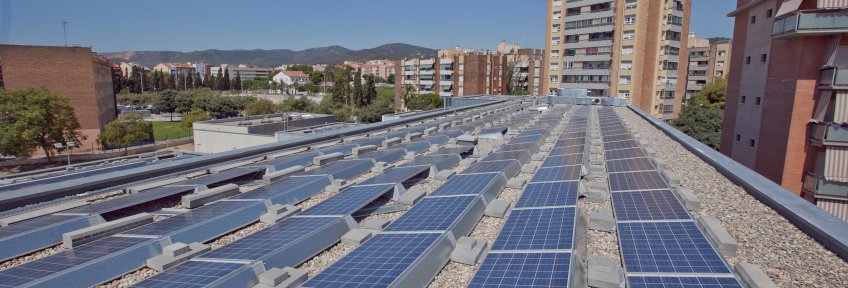
The Spanish city of Viladecans launched a public-private partnership, Vilawatt, for energy governance in 2017. The project has set up a public-private-citizen partnership (PPCP) and manages four main services: Energy supply (from 100% renewable source), consulting and training to raise energy awareness and energy culture, energy retrofitting of buildings, and new local currency linked to energy savings.
Vilawatt is a highly innovative project because this is the first time that the local government of Viladecans, with a population of 66,000 inhabitants, drives the energy transition process through the establishment of a local energy company that successfully combines energy demand of the community to achieve more competitive prices, encourage the issuance of a new local currency linked to energy savings, and retrofitting private buildings by entering into repair and retrofitting bidding. No other European country has ever tested the governance structure adopted in this process which entails PPCP. On another note, the project included a participatory strategy involving 10 social entities that play a key role in the energy transformation of the city and offered learning and sharing spaces aimed at facilitating the decision-making process within the energy company.
The Vilawatt project is based on the PPCP consisting of the Viladecans City Council, the Barcelona Metropolitan Area, and two associations: The Citizen Association for Energy Transition and the Business and Retailers Association for Energy Transition. The City Council currently holds 80% of the rights and obligations of the partnership and the Barcelona Metropolitan Area holds 10%, while the remaining 10% is held by the two above-mentioned associations.
Energy supply: Under Vilawatt, the demand for energy is pooled by all users (members of the different associations and public contracts of the Municipality) and electricity is purchased in bulk. Through collective buying, the partnership acts as a single customer buying from the supplier, which makes it possible to negotiate better prices and services. Municipal buildings are included in the collective buying group, which confirms that the energy purchased is 100% renewable and follows two ISO environmental standards: 14001: 2014, thus ensuring that the activities are managed in an environmentally friendly way, and 9001: 2008, which applies a series of guidelines based on an international consensus on good management practices.
Faster repair and retrofitting of private sector buildings: One of the main axes of the project is the repair and retrofitting of residential buildings in the Montserratina district and improving energy contracts for local residents. Energy retrofitting in Viladecans has not progressed as planned, partly due to a lack of private investment, which highlighted the need for a more comprehensive approach by the Vilawatt partnership. As for Montserratina, the homes of approximately 20,000 people – or 30% of the city’s population – were built before 1976, when Spain started adopting energy legislation knowing that the income of residents was about 15% lower than the city average. The project generated €1.4 million for the repair and retrofitting of three demo buildings, which will be energy-monitored throughout the process.
Consulting services and learning communities: Vilawatt has launched several learning communities and training sessions in the field of energy efficiency and renewable energies (including schools, the retail sector, companies, unemployed citizens, etc.). The project also enhanced energy audits and contract optimization services to reduce energy consumption, encourage citizen participation, and promote behavioral change.
Financial incentives to rationalize energy consumption: By issuing the local electronic currency, Vilawatt offers financial incentives for participating families who are paid in that currency, which can be used in local stores in exchange for energy.
During the first two years of its inception (2017 – 2019), the project began benchmarking and studying the legal forms of the PPCP and the electronic currency to raise community awareness and change the mentality toward energy. The PPCP or consortium (the legal form of the PPCP) was established in April 2019 (with the City Council of Viladecans and the Metropolitan Area of Barcelona). In November 2019, the Citizen Association for Energy Transition and the Business and Retailers Association for Energy Transition joined the PPCP.
The local company began providing services in July 2019 and initiated the repair and retrofitting of the three buildings (with a €1.4 million investment) in December of that same year. The repair and retrofitting will result in a 60% reduction in energy consumption in the three buildings. Work is also underway to develop learning communities and establish a network of companies and projects that will accept the local currency.
This project is in line with the EU Energy Strategy. Viladecans Municipality seeks to accelerate its ambitious energy transition project to achieve the 2030 Energy Strategy targets. As a signatory in the Covenant of Mayors, the Viladecans Municipality has a Sustainable Energy Action Plan (SEAP) aimed at reducing emissions by 22% in 2020, which will be improved to a 40% in 2030. After implementing the SEAP procedures on energy savings and energy retrofitting in public buildings, work will begin on private residential buildings.
Resources: