

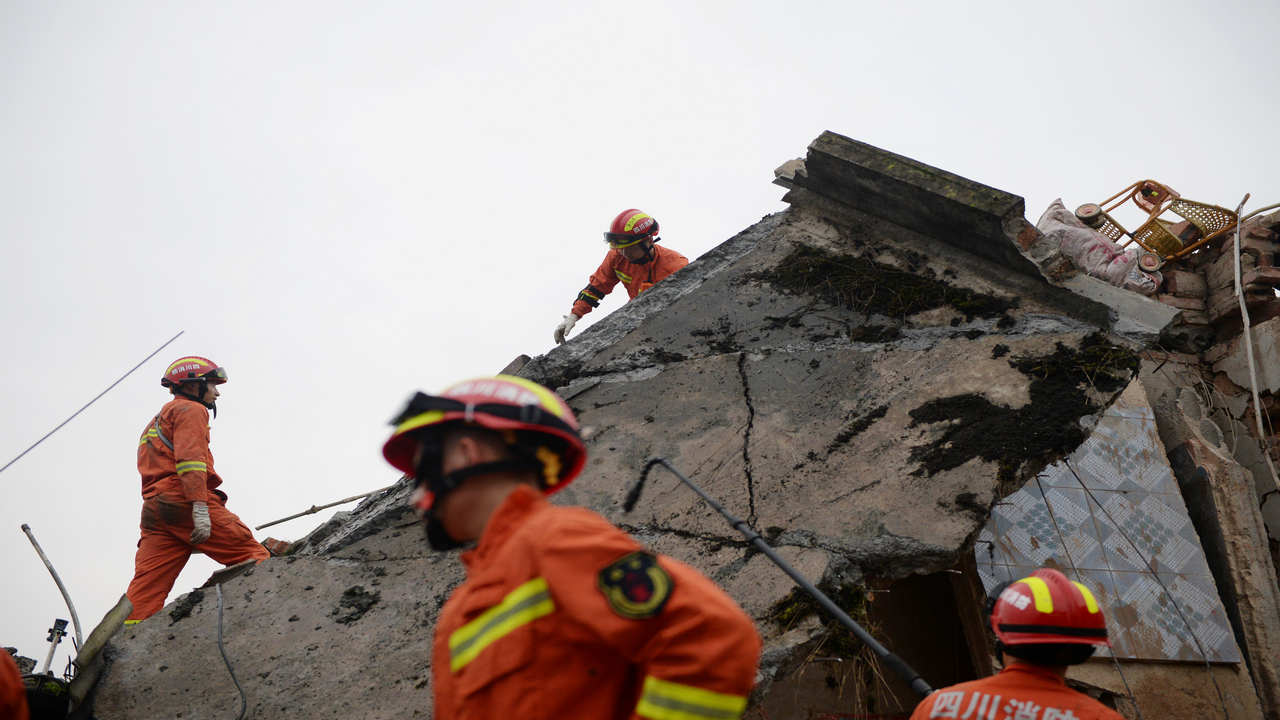
Natural phenomena have been one of the most dangerous factors that have threatened many civilizations throughout history. China has had its abundant share of it. Especially earthquakes that led to major disasters and caused human and economic losses. In order to address the risk of earthquakes, The Chinese government, through the China Earthquake Management (CEA), recently presented its latest innovation in disaster response. It is an early warning system that monitors the first waves of earthquakes and sends alerts within the vicinity of the disaster, And through different means of communication in just 5 to 10 seconds, To alert residents and launch earthquake rapid response operations.
Earthquakes, hurricanes, volcanoes and other natural disasters threaten the safety of many cities around the world and cause concern to relief authorities and civil defence teams. Governments have been developing ways to prevent and respond to natural disasters for decades. Research centers continue their efforts to devise technologies that contribute to predicting and warning of imminent occurrence. In fact, there is a difference between predicting earthquakes and alerting for their occurrence. Because forecasts are made before an earthquake, It is an urgent global challenge that requires constant research and monitoring of many natural phenomena. As for the alerts, They are attempts to alert residents and authorities after the start of the earthquake, That is, it takes place within a narrow time frame, It requires high coordination and advanced technologies.
In China, It is one of the leading countries in technology, A devastating earthquake struck Wenchuan County in 2008 and killed more than 69,000 people. It also led to soil loosening, making the area vulnerable to geological disasters such as soil slides. Following this incident, Earthquake early warning laboratories in China have moved towards developing warning systems to prevent the recurrence of such a disaster. But disaster response systems, especially earthquakes, need two important characteristics: the ability to operate with infinite speed and accuracy.
As part of efforts to develop earthquake early warning systems, Since 2018, China Earthquake Management has been preparing an early warning network as the latest innovation offered by the Chinese government in this field. The network will begin its work by the end of next year. This network will issue alerts of the approaching earthquake seconds before the start of its destructive waves, By sending warnings to people within a distance of more than 20 kilometers on the perimeter of the epicenter, This is to enable them to avoid danger and be in safe places. The system directs early warning messages through television, radio, smart phone applications and media platforms, These alerts will include many vital facilities, Among them are more than 3,000 schools and dozens of railways, Observation stations have been built covering about 40% of China’s train network and extending for about 13,000 kilometers.
These systems depend on the nature of the seismic waves, The first seismic waves are usually weak and have relatively limited impact, But it sets the stage for the next most powerful waves. Therefore, The system is programmed to monitor the first waves via sensors and use satellites to send warnings seconds before second waves cause strong ground vibrations. The stations are connected to monitoring systems, communication networks, data processing and emergency earthquake information service systems. After receiving alerts, The authorities shall be able to take the necessary measures to evacuate the population and protect infrastructure, vital facilities and engineering projects, In addition to carrying out emergency stop measures for high-speed trains and closing gas pipes.
Since the inception of the project, The China Earthquake Administration has built more than 15,000 observation points across the country and put them into trial operation. Having tested specific stations in several provinces over the past three years.
Since it was not possible to collect all the necessary data from a single location, Especially in the most earthquake-prone areas, The China Earthquake Management has decided to meet this challenge by ramping up monitoring stations at specific locations. In this way, Several series of observation stations have been deployed in some key areas such as northern China, the seismic belt area and the coastal zone separating each station by 12 kilometers.
During this year alone, The system’s warnings helped prevent 3 earthquakes in Yunnan province, Their severity ranged from 5.0 to 6.4 on the Richter scale. In Yangbei Province, hit by the three strongest earthquakes, The system was able to deliver alerts to 14,000 housing units via television within 7 seconds of the first tremors. This has calmed the population and enabled the authorities to launch a timely emergency response.
This system currently covers 31 provinces and municipalities, Since it was issued, it has issued 40 warnings, none of which were wrong. The “China Earthquake Administration” had estimated when the project began a few years ago that it would take 5 years to complete. It will play an important role in disaster reduction and provide essential information on early warning techniques, To study natural disasters and achieve a rapid and effective response based on scientific foundations. It has also achieved an advanced speed rate globally, China is the third country after Japan and Mexico to have this advanced level of earthquake warning capability.
Multi-hazard early warning systems are of interest to the United Nations, which has developed a plan to deploy and operate these systems in most countries of the world by 2030.
References:
http://english.www.gov.cn/statecouncil/ministries/202108/09/content_WS611081a2c6d0df57f98de376.html
https://www.globaltimes.cn/content/1203521.shtml
http://english.www.gov.cn/news/videos/202109/14/content_WS61400a4fc6d0df57f98e025d.html