
India has one of the largest and busiest transport networks, The Indian government seeks to enhance the safety of its citizens through public-private partnerships to use technology-based solutions and integrate innovations geared towards protecting women in public transport.
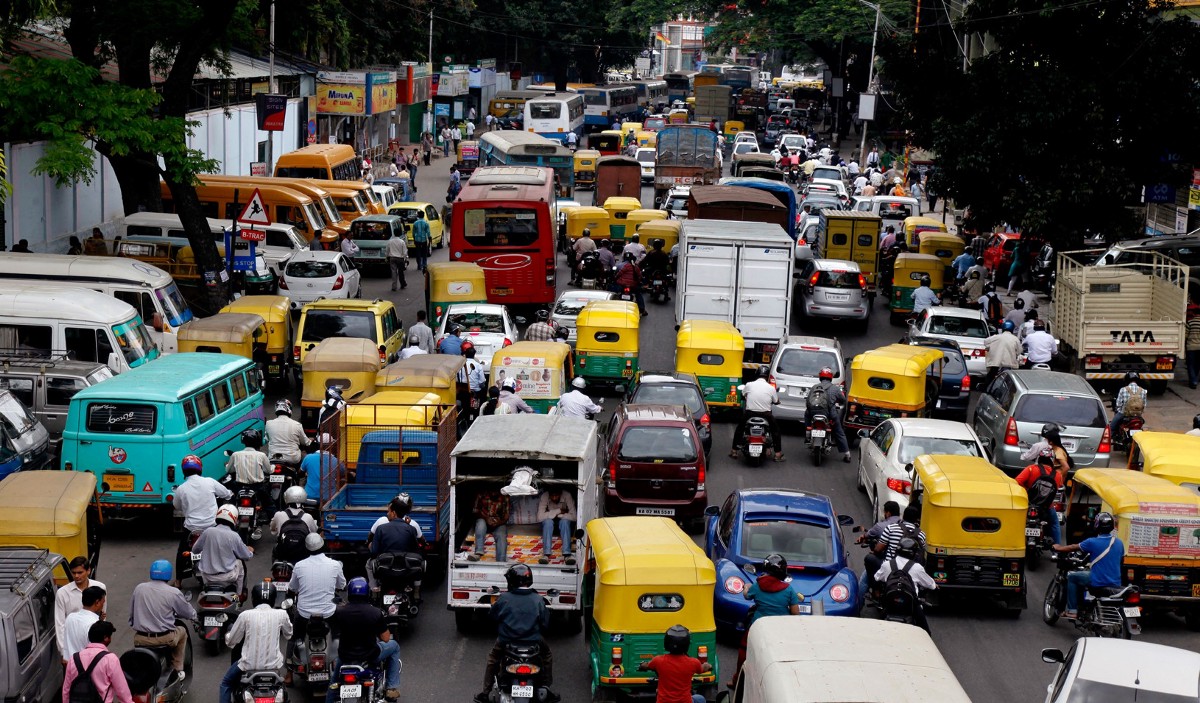
Hundreds of millions in India go out of their homes every day to work or study. They traverse different roads, Starting from walking through the mountains, And not ending with riding subways, This makes the government’s attention to road safety and strategies to enhance it vital.
Statistically, As a country’s population increases, The complexity of its transport networks has increased, Road safety ratios have declined. As expected, India tops the list of global road traffic deaths, It alone accounts for 11% of them. According to a World Bank report last year. The lockdown measures imposed in 2020 could not prevent these incidents. The lives of 120 Indian citizens were taken away, according to the National Crime Records Bureau. But what is interesting is that half of these accidents are concentrated on 5% of roads.
In the face of this reality, The Indian government has set a goal of halving the number of deaths by 2030. It began this endeavor with the launch of a project called “Smart Road Safety Solutions through Technology and Engineering”. Which came as a result of the cooperation of several partners, As an Indian Artificial Intelligence Initiative, The Higher Institute of Information Technology in Hyderabad, Central Road Research Institute of the Council for Scientific and Industrial Research, Private sector partners, and the Nagpur City Municipal Authority.
The innovation consists in adding the preventive element to the corrective methodology traditionally adopted in the field of road infrastructure. Towards this goal, Each partner made his contribution, Intel has developed an advanced driver assistance system, A camera mounted on the windshield of the car scans the entire road in front of it, Complex algorithms are used to measure potential hazards, As soon as any of them have been detected, The system issues an audible and visual warning to the driver, If he approaches the vehicle in front of him too much, is about to collide with a pedestrian or deviates from his lane without sending a signal, The system instructs him to slow down, maintain a safe distance, or correct the lane. The government has adopted this system on one of the highways in the capital to control violations, capture car plates and monitor any defects in their information. It plans to implement it nationwide.
In turn, The Central Road Research Institute (CRI) provided its engineering expertise, which was integrated with the expertise of the private sector in leading major road initiatives, including public awareness programs and driver training in Nagpur. whose municipality has adopted collision avoidance technology, It has installed sensors in a fleet of buses that ply the city. This technology modifies the behavior and orientation of drivers.
The city is also trying to take advantage of the predictive potential of artificial intelligence to repair road infrastructure, Where the team of developers uses statistical analysis of different regions, They review the rates of previous accidents and deaths, If they reach high levels, They classify the area as a “black spot”, To transfer its file to the Department of Detailed Road Engineering, which is studying ways to improve its infrastructure.
The Higher Institute of Information Technology has worked for years with Intel to generate data for everything related to the traffic landscape in India. He studied the condition of the roads, the behavior of drivers and the types of cars, He then organized that information into what he called the Indian Driving Data Collection. To be a reference for researchers working on the development of algorithms.
Among the results of these efforts, The institute has developed an algorithm that uses machine learning and computer vision to detect driver drowsiness. Through a lens, it follows facial features and detects facial expressions such as closing eyes or yawning. Another AI-powered initiative called Panic Alert has also been launched. It is an innovation aimed at women and children, The bus is equipped with 4 buttons, 3 cameras and a mobile network video recorder that uses artificial intelligence and is connected to a control center powered by the cloud computing system. If any woman or child is harassed or threatened by another passenger, Pressing the button allows documenting the incident and informing the workers of the control center and the city police for special teams hired by the Ministry of Transport to respond. The system has been installed on 500 buses in Chennai and will be added to another 2,500 as part of the Safe City of Nairbaya initiative. These efforts coincided with the placement of 66 bus stations in the capital under surveillance.
But the challenge facing the project is the nature of the smart solutions developed in the West to simulate a reality that is completely different from the Indian reality. Therefore, The team had to make a determined effort to adapt the developed technology to local data.
The diversity of partners contributing to this project has been translated into a diversity of experiences and benefits, The Leadership Data Set will be of great help to researchers. Sensors also help with their data identify potential hazards in an area to create a key indicator of black dots. The Public Transport Bus Safety Project will help detect accidents and improve the lives of women and children.
For now, Various Indian cities are considering replicating the Nagpur experience and adopting technology to improve bus performance on highways and increase traffic safety rates across Indian territory.
References: