
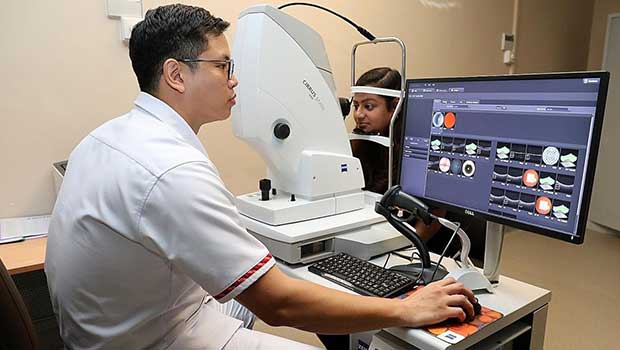
To promote the harnessing of technology in the health sector, A team of Singaporean researchers has developed an AI-powered system, It examines eye images of people with diabetes to diagnose eye disorders in a way that reduces the human effort required to conduct these tests by 70%. Its duration is shortened to minutes.
In this context, Singapore operates, The leading country in the employment of technology, the implementation of the National Strategy for Artificial Intelligence, Aimed at establishing a comprehensive system of artificial intelligence in the country. The strategy targets 5 government sectors, One of the most important is the health care system. Through these efforts, the government aims to reduce spending and improve the outputs of the health sector. Especially with the increased pressure on medical staff due to the challenges facing Singapore resulting from the phenomenon of population ageing. Efforts are directed to address the pressing health issues of the increasing prevalence of chronic diseases and their complications. Foremost among them are high blood pressure and diabetes. The latter is the fastest growing chronic disease ever. Where hundreds of millions around the world coexist with it, It has a huge negative impact on their lives.
Diabetic retinopathy is one of the serious effects of diabetes, It is the number one cause of vision loss in adults around the world. The diagnosis of this disorder requires careful examinations carried out by specialists. Using advanced devices and equipment that are not necessarily available everywhere.
In Singapore today, These examinations are performed by experts trained in reading eye images at a medical centre at Tan Tok Singh Hospital (TTSH) and at the National Eye Centre of Singapore (SNEC). Fewer than 10 employees read more than four thousand images a day by viewing them on a screen in a dark room. They are not usually allowed to work for more than half a day, The process is laborious, tiring and time-consuming.
To facilitate these examinations, A research team from the Singapore Eye Research Institute (SERI) of the Singapore National Science Centre (NUS) and the National University of Singapore (NUS) School of Computing have developed a machine learning system called Selena+ that handles diagnostic tasks that are usually carried out at the initial screening stage. Where the process of diagnosing diabetic retinopathy is divided into 3 stages, In the first stage, staff exclude half of the eye images of diabetics that are sent to the diagnostic center for lack of any signs of the disease. In the second stage, the other half is checked with 10% of the images that were excluded because they were free of symptoms. In the absence of a definitive diagnosis, About 5% of the images are sent to an ophthalmologist for reading.
Selena+ has been licensed to launch locally after setting up its AI software. He is trained to analyze images of the retina after scanning them for any symptoms of diabetic retinopathy.
The technology can monitor the symptoms of 3 eye disorders resulting from diabetes, The first of these is the yellow and red spots in the retina, which indicate diabetic retinopathy, Then there is evidence of “glaucoma” disease that affects the optic nerve, And others indicate some age-related eye diseases.
To prepare a reference base for the system, The researchers provided him with more than half a million sets of data collected from Singapore’s Integrated Diabetic Retinopathy Program, which was launched in 2010 to provide eye screening for diabetics in the country.
To conduct the examination, Digital cameras with specialized lenses called the “fundus camera” take pictures of patients’ eyes, The images are transferred to a computer with the Selena+ system, which allows artificial intelligence algorithms to perform the assessment. The system also uses machine learning technology, That is, its results become more accurate as the stock of the images analyzed increases.
While artificial intelligence is still an emerging technology, Many experts raise doubts about the privacy of individuals, especially in the field of healthcare. To meet this challenge, The authorities are working to establish a framework for the health sector to complement the AI governance framework developed by the Personal Data Protection Committee, Which was launched last year.
One of the advantages of the artificial intelligence feature is that it is accurate and reliable performance, This innovation can support the health sector’s efforts to confront diabetes and its repercussions. Such as monitoring changes in the blood vessels in the retina to infer the state of the heart and circulation or monitoring narrowing of these vessels to diagnose high blood pressure. Thus, The results of instrumental analyses can be used with clinical and biological indicators to create a predictive model for assessing health risks at the state level.
According to preliminary tests, The “Selena+” system was able to shorten the duration of the eye examination from an hour to 3 minutes and show the results directly if they are “normal”. So that everyone, Even from remote rural areas, Undergo early screening to prevent diabetic blindness and receive results almost immediately.
The system is expected to be adopted across Singapore following regulatory approval from the Health Sciences Authority. Which will make it the first artificial intelligence product used for medical examinations by a national health system. In the hope of spreading the experience to other countries, The developers worked on programming the algorithms and interface to be adaptable to different languages.
In the future, artificial intelligence can also be used to develop treatment plans and support primary care teams. This is part of Singapore’s plans for the coming years dedicated to making the best use of AI and upgrading primary health care.
References: