

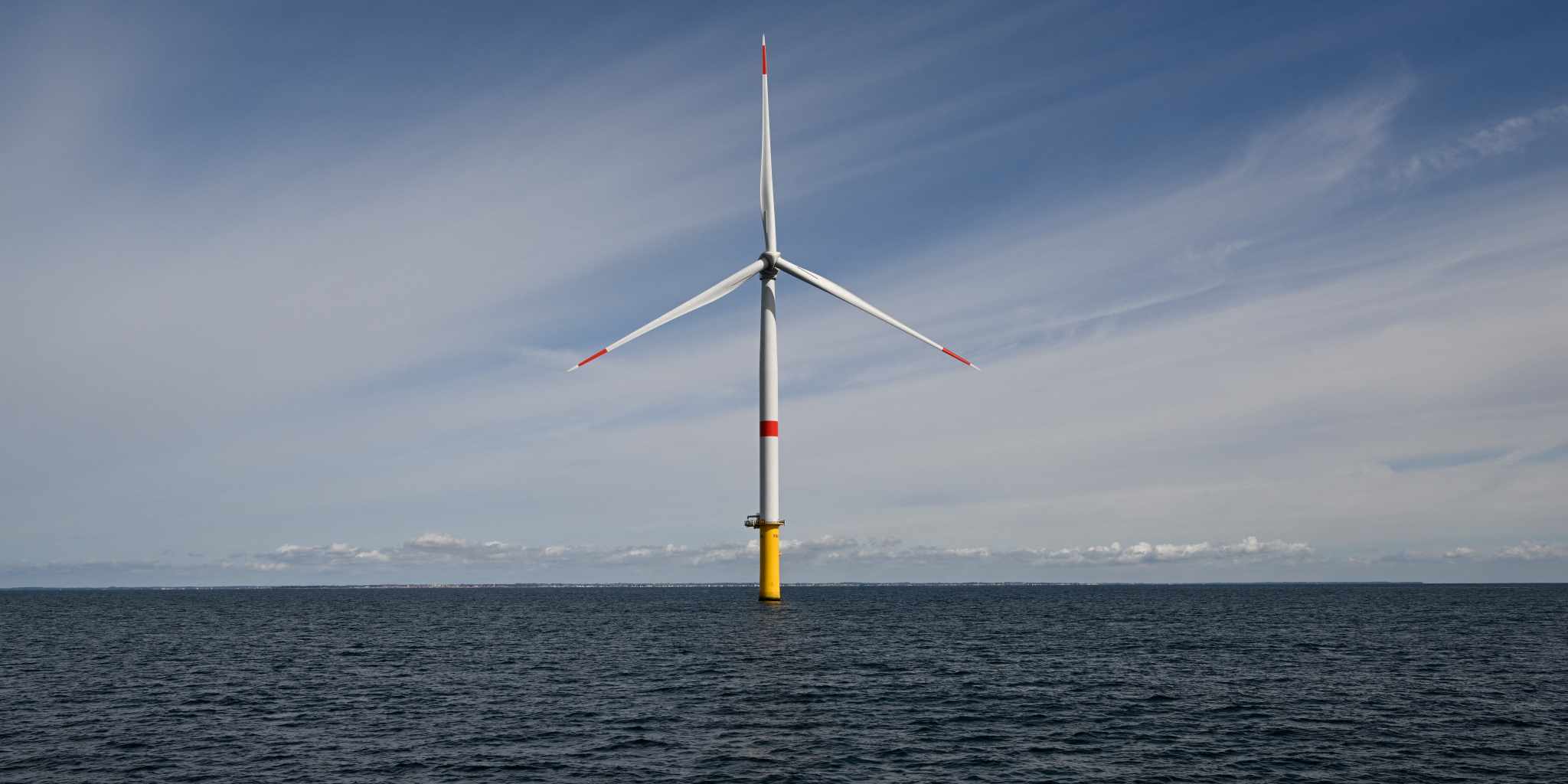
To benefit from a wind resource provided by deep water areas, countries such as the United States, France and Japan have begun installing floating platforms in the middle of the sea, topped with turbines that generate electricity from the wind, mounted on different bases, according to budget, depth and estimation of the energy generated.
Old windmills that people used to see on farms, regardless of their primitiveness, is similar to the shape of wind turbines that today represent revolutionary technology for generating electricity from renewable sources. In 2021, with a rapid growth of 17%, these turbines generated a total of 830 GW of power, 93% of them were onshore sources, which means that the technology has not yet been invested in points where wind speed is at its peak, i.e. in deep water areas.
On land, weather conditions fluctuate considerably, especially the wind. In the European Union, for example, after years of near-record growth, the years 2020 and 2021 brought low-intensity winds, reducing production by 3%.
In fact, fans must be at a certain altitude to maximise the utilisation of wind energy, as they are installed on tower poles, which is easy on land, and average difficulty in surface water. However, when talking about deep water, it is impractical and even impossible to stabilise these tower poles on the seabed, and even if they are stabilised, the bottom level may drop at any moment as a result of the movement of the tectonic plates.
The records exist, but they do not negate the fact that wind turbines are still in the primary stages, and are awaiting smart and economical ways to realise the enormous potential they promise, as is happening in the United States, Japan and the Mediterranean basin.
One of these methods is called “floating wind turbines”, where turbines are placed in areas that are more exposed to high winds, without poles that stabilise them to solid ground, and in such a way that they are both wind resistant.
The US state of California launched one of the pioneering experiments, taking advantage of the strong offshore winds of its north coast, and seeking to meet the great demand for hydropower supplies, with the federal government holding a public auction for private companies to lease spaces of sea for “floating wind turbines” projects.
A floating wind turbine works just like other wind turbines; wind pushes on the blades, causing the rotor to turn, which drives a generator that creates electricity. But instead of having its tower embedded directly into the ground or the seafloor, a floating wind turbine sits on a platform with mooring lines that hold it in place and keep it connected to the cable that sends its electricity back to shore.
There are three main types of platforms: a spar buoy platform, which is a long hollow cylinder that extends downward from the turbine tower. It floats vertically in deep water, weighted with ballast in the bottom of the cylinder to lower its centre of gravity. It’s then anchored in place, but with slack lines that allow it to move with the water to avoid damage. The second type is semisubmersible platforms, which have large floating hulls that spread out from the tower, also anchored to prevent drifting.
The third type is tension leg platforms, which have smaller platforms with taut lines running straight to the floor below. These are lighter but more vulnerable to earthquakes or tsunamis because they rely more on the mooring lines and anchors for stability.
Each platform must support the weight of the turbine and remain stable while the turbine operates. Since some can be fully assembled in port and towed out for installation, they might be far cheaper than fixed-bottom structures, which require specialty vessels for installation on site.
This innovation was not limited to America alone, as several similar pilot projects were also launched in Europe, where France, which has the longest coastline on the continent, started building the first floating wind farm with a capacity of 250 megawatts.
In Asia, Japan’s first experience, funded by the Ministry of Economy, Trade and Industry, appears to be the first to be an early alert to the concept, opting for a location about 20 kilometres off the Fukushima coast, which has a medium speed of at least 7 metres per second, which qualifies it to produce 14 megawatts of energy.
The United Kingdom also embraced several projects in which the public and private sectors cooperated, at a cost of more than £60 million, with the aim of producing 5 gigawatts of energy by 2030. This technology faces many challenges, including that the movement of the platform may increase the force applied to blades and shafts, increase the complexity of aerodynamics and reduce their stability. It’s a big risk, especially given the cost challenge that doubles as the depth of water increases and can be mitigated by installing larger turbines on platforms, each of which can produce 10 megawatts of energy, which is more than a number of times the production capacity of onshore turbines. This will provide a huge leap on the path of complete reliance on clean energy.
References:
https://www.gov.uk/government/news/60-million-boost-for-floating-offshore-wind
https://www.iea.org/reports/wind-electricity
https://www.bbc.com/news/science-environment-63300959
https://www.weforum.org/agenda/2022/12/floating-wind-turbines-us/