


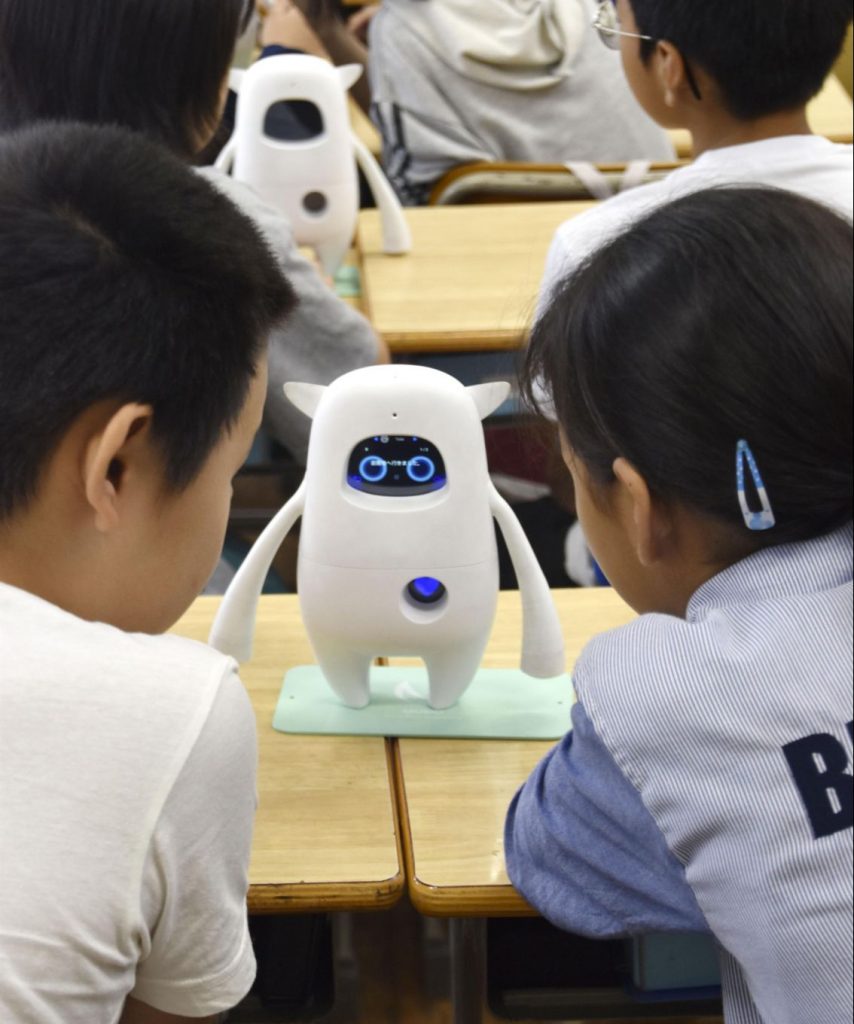
To take advantage of the great potential of robots, Some Asian countries have begun experimenting with their use in education. Such as robots that stimulate thinking and motor activities that appear in kindergartens in Taiwan, Korea, China and Singapore, And those that help to learn foreign languages in Japan.
Through years of technological development, In many parts of the world, Robots have taken root as an integral part of everyday life, It is no longer surprising that she undertook many human tasks in scenes that were not so imaginable not so long. For example The sight of robot arms in pharmacies stretching to bring medicines from shelves quickly and accurately has become familiar in many hospitals. As in some exhibitions toured by robots greet visitors and guide them to the halls.
But the educational sector may be one of the most needy sectors for this technology, The classroom environment is not without restrictions that deprive some students of what they need to develop. Modern educational theories also direct teachers to focus on interactive activities, although they lack many of their requirements such as flexibility, model numbers, large space, sufficient time and qualified staff.
On the other hand, Most countries seek to build a generation with technological knowledge to advance the country. But at the same time, they should not overexpose children to technology and screens because of the damage it has on their motor and cognitive development and mental functions.
Whereas, the educational technology used to facilitate learning and improve students’ academic performance is manifold, There have been some timid attempts to integrate robots into education in several Asian countries.
generally Classroom robots are used in different ways, It covers 3 main categories of materials, Namely, languages, And technical subjects such as informatics, engineering, mathematics and programming, and non-technical subjects such as biological sciences.
In Taiwan, The Industrial Development Office at the Ministry of Economic Affairs is working on a joint venture with the private sector. Named “Smart City”, It comes in response to the government’s goal of promoting technological transformation. In the education sector, AI Technology is working with the Senzhou city government to develop smart educational aids such as tablets for use in kindergartens. The project also presents a smart robot called “Keppi Air S”, It is a smart educational partner that takes the hand of children to explore information, It helps teachers deal with children with special needs and intervene quickly in emergency situations. This innovation has been provided to 58 educational institutions from kindergartens and private care centers.
In a similar experience, Seeking the Korean capital, Seoul, To prepare the next generation for a high-tech future, It launched the robot “Alpha Mini”, which does not exceed 25 centimeters in length, He can dance, sing, read tales and teach sports movements. He then instructs the children to simulate his movements, documents their activity via the camera attached to it, and transmits it directly to the connected tablets. The government has directed the use of this innovation with children aged 3 to 5 years, To begin testing them in 300 nurseries and care centers, That’s half the number China has chosen to try out its version of the script-based educational robot that asks questions to students. It offers encouraging graphics when they find the right answers.
In Singapore, The Media and Information Communications Development Authority (MIDA) has launched the “Toy Maker” project, which has introduced robotics to 160 nurseries since 2016. To allow children to learn technology without relying on screens, Among them is a robot named Kibo, It is equipped with wheels, sensors, lights and motors, It is programmed to perform simple tasks such as receiving instructions, moving in a certain direction and turning on the light to teach children the basics of science, technology, engineering and mathematics.
In the Japanese experience, In 2018, schools began focusing on using robots to teach English and help students with communication difficulties. This project came in preparation for a major change in the government curriculum, which will begin by requiring students to start learning English from the age of ten. This is despite voices opposing this idea, which sees it as a neglect of the Japanese language.
In any case, Dialogue with robots remains restricted, Because it needs to convert audible speech into written text to analyze it and formulate an appropriate answer, That is, they do not replace the presence of teachers. Here, An important challenge arises, It is the extent to which teachers are familiar with this technology, provide training needs to enable them to deal with them, and even accepting its presence in their ranks, Not to mention being their partner, No entertainment or distraction.
On the other hand, Many question the ability of any educational system to afford to introduce robots into its halls on a large scale. Especially since it is rapidly evolving, The shelf life of these innovations is only a few years.
All of this reduces the likelihood that robots will be part of formal education over the next decade. But he does not deny that it has proven its usefulness in several aspects, Post-learning cognitive tests have shown that young children perform better and show greater interest when they receive language information with the help of robots rather than audio recordings and books. It turns out that students do not hesitate to try to pronounce foreign vocabulary in front of robots, And they are not ashamed to make mistakes with her, Especially since she can continue training and repeat the information for a long time, And you won’t feel as tired as a real teacher.
In Taiwan, After more than 3,000 teachers and students benefited from the smart robot, The company is working with other local governments to expand the experience.
In general, The results of these projects are not yet clear. But experiments will be a generous resource of data, It may establish future projects that apply the best methods for employing robots in the educational process.
References:
- https://smartcity.press/taiwan-smart-learning-partner/
- https://www.theguardian.com/world/2021/nov/25/south-korea-trials-robots-in-preschools-to-prepare-children-for-high-tech-future
- https://www.theedadvocate.org/robot-teachers-invade-chinese-kindergartens/
- https://apolitical.co/solution-articles/en/meet-the-robots-teaching-singapores-kids-tech
- https://www.oecd-ilibrary.org/sites/1c3b1d56-en/index.html?itemId=/content/component/1c3b1d56-en#section-d1e17814
- https://www.researchgate.net/publication/251237835_A_review_of_the_applicability_of_robots_in_education
- https://www.zdnet.com/article/japan-set-to-deploy-english-speaking-robots-to-schools-report/
- https://www.straitstimes.com/asia/east-asia/japan-classrooms-to-use-ai-robots-to-help-teach-english
- https://www.straitstimes.com/asia/east-asia/seoul-trials-pint-sized-robots-in-nursery-schools
- https://foreignpolicy.com/2020/05/26/japan-doesnt-want-to-become-another-casualty-of-english/