

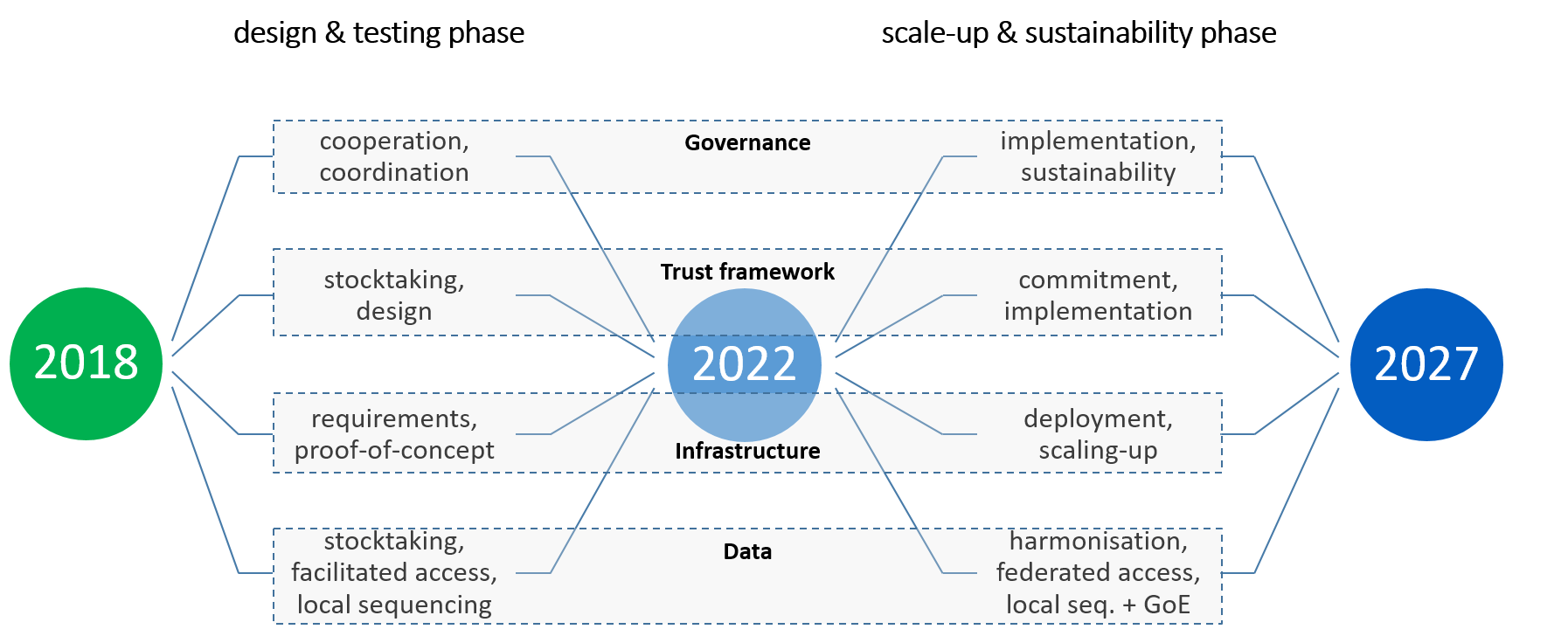
The European Union has launched the ambitious “1+ Million Genomes” initiative to revolutionize healthcare through personalized medicine. By establishing a secure infrastructure for genomic and clinical data, fostering collaboration among 25 countries, and setting international standards, this project aims to usher in a new era of precision medicine.
Historically, curiosity has driven humanity to explore the unknown, from the workings of the universe to the intricate details of the genetic code. Genomics, the study of genes and genomes, has opened up new possibilities for healthcare. Genomics can be defined as the complete set of genetic instructions present in a cell. In a data-driven world, there is a growing demand for advanced healthcare solutions that leverage vast amounts of genomic and clinical data. Traditional healthcare systems often struggle with fragmented and inaccessible data, hindering the development of personalized treatments and effective disease prevention strategies. Even in scientifically advanced European countries, there is a need for a secure infrastructure that enables seamless sharing and analysis of genomic data.
To address this challenge, the European Union launched the “1+ Million Genomes” initiative in April 2018. This initiative brought together 28 European partners from 25 countries, including academia and industry, aligning with the EU’s digital health transformation agenda and the European Health Data Space.
Genomics has the potential to revolutionize the treatment of diseases such as cancer, rare diseases, and neurodegenerative disorders. Over time, genomic data can be used to create detailed patient profiles, supporting the concept of personalized medicine.
The first phase of the initiative, in 2020, focused on operationalizing the roadmap, developing legal and technical guidelines, and establishing data standards, requirements, and best practices. A dedicated website provides access to this information.
In late 2022, the Genomic Data Infrastructure project (GDI) was launched, focusing on a comprehensive communication strategy for information sharing. To formalize and facilitate strategic cooperation and coordination, the Commission established a dedicated group of representatives from the signatory countries. This group includes 12 specialized working groups of national experts who define specifications and guidelines.
In late 2023, the group approved the roadmap for 2023-2027, named the “Scaling and Sustainability Phase,” outlining activities to implement recommendations. This phase includes establishing and operating a technical infrastructure, conducting clinical pilot studies, generating additional high-quality data, creating national coordination mechanisms, and linking the infrastructure to the European Health Environment Assessment Network and other relevant EU initiatives. The roadmap also includes five implementation tracks related to different data domains and diseases: synthetic data, rare diseases, cancer, complex diseases, infectious diseases, and the European Genome.
The European Genome is a large-scale project co-funded under the Digital Europe Programme. Each participating country will create a national reference genetic data set through whole-genome sequencing of its population, both healthy and diseased, based on common guidelines. These national reference sets will feed into a larger European reference set, providing a world-class data resource co-created by 100,000 individuals.
However, scaling up such an initiative presents various challenges. Creating a suitable infrastructure across Europe is complex, as is ensuring secure and unified access to genomic data and overcoming interoperability challenges.
Ethical and legal concerns regarding data privacy and security, as well as the safe sharing of sensitive patient information, are also inherent in such projects. Addressing these concerns will require building public awareness and gaining the trust of policymakers.
By 2026, 16 countries are expected to have established their operational infrastructures, promising to revitalize their health systems and economies. This could open up new markets, services, professions, and therapeutic products.
The “1+ Million Genomes” initiative will enable more accurate diagnoses in less time, enhance prevention, and improve the value of healthcare investments by developing drugs, treatments, and interventions tailored to individual patient needs.
By facilitating sharing, ensuring accuracy and speed, the initiative will increase the information available to researchers and healthcare professionals, enhancing their understanding of diseases, supporting personalized medicine, benefiting patients, and improving the efficiency of healthcare systems. Perhaps most importantly, this initiative heralds a future where personalized medicine becomes the cornerstone of healthcare practices.
References: