
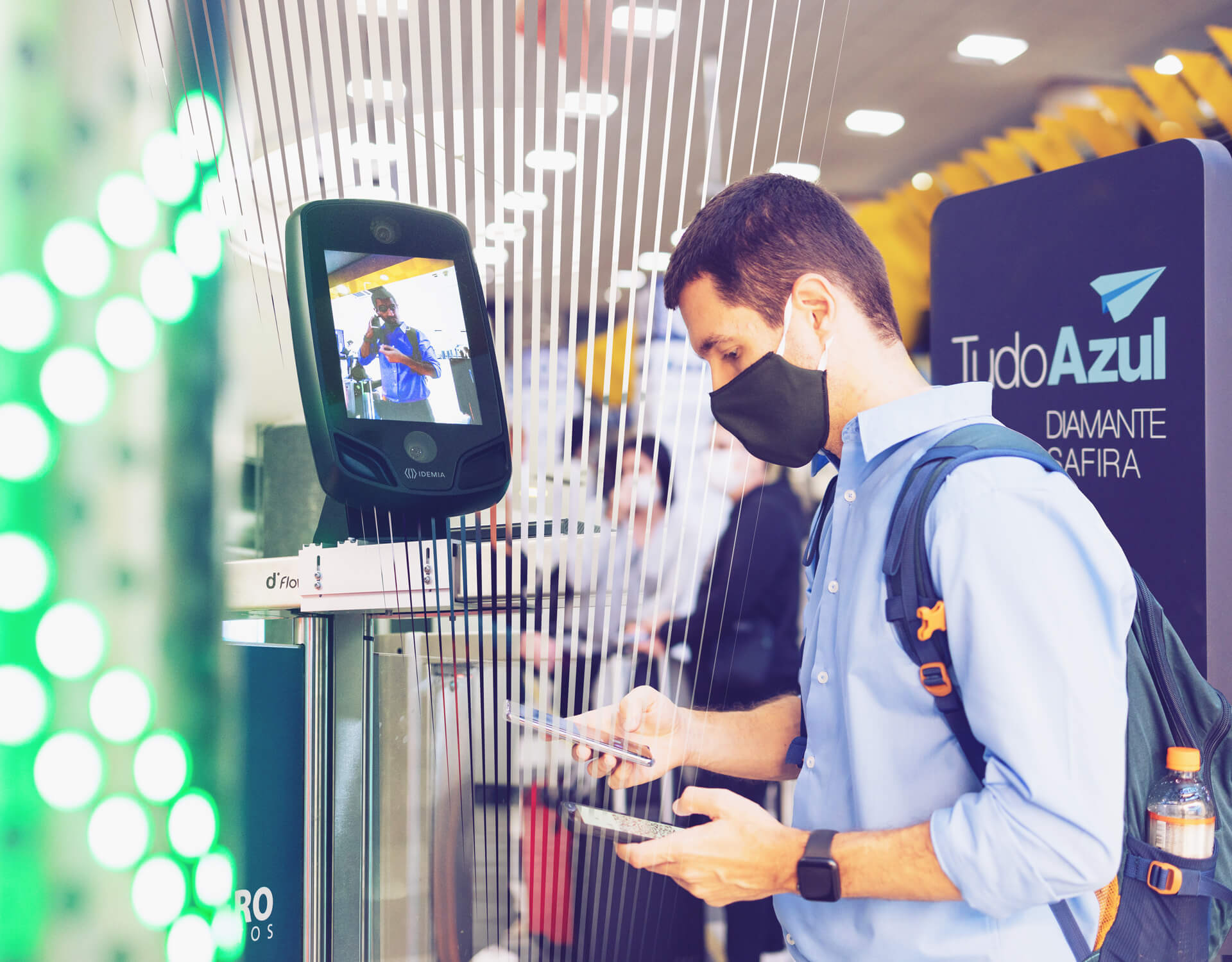
Brazil has recently moved to employ facial recognition technologies at airports to facilitate passenger procedures. The new system scans the biometrics of travelers’ faces and then verifies their data in national databases.
Because airports are very important sites and often bustling with travelers, They require precise, complex and sometimes confusing security procedures for passengers and airport staff alike. Starting from booking, check-in, check-in and baggage procedures, passing security tests, and then finding the right gate, These procedures may take hours before the passenger enters the aircraft, Its organization also requires considerable effort by airport staff. The COVID-19 pandemic has complicated the matter, Where its impact affected air traffic just like any other field, Due to the imposition of travel restrictions, the disruption of air traffic and the closure of many countries to their borders, Therefore, innovative solutions had to be found to compensate for the material losses incurred by airlines, Meet the need for communities to travel by air again while ensuring the safety of travelers and adhering to preventive measures.
In Brazil, The Ministry of Infrastructure and the Department of Administration and Digital Government of the Ministry of Economy collaborated with Serpro. It is an information technology company in the government sector to reduce bureaucracy in devising a solution based on “Augmented Identity” technology, Using the face recognition system, which today has become a global trend to facilitate and secure procedures. The data necessary for the development of this service have been obtained from the Brazilian Government, It is included in the technologies developed by a number of private companies, including IDEMIA, to launch an integrated digital system to be applied at Brazil’s airports. As a first step, this system underwent a world-first trial of short-haul flights domestically at Cogonhas and Santos Dumont airports. This comprehensive technology has been tested by inviting passengers on those flights between Rio de Janeiro and São Paulo, To participate in the experience by using facial recognition technology in the boarding areas of both airports.
Instead of presenting a boarding pass and presenting personal documents, The principle of facial recognition technology is based on capturing facial biometrics within seconds. To apply the experiment, The airport management has invited passengers who have to go through boarding procedures to participate in the experience. And then send a text message to their mobile phones if they agree to request permission to access their data, Including social security number and personal photo. With the consent of the passenger, The app is used to verify its identity and compare the data and image taken directly with those within national databases.
The identity of the passenger and the correctness of their data are then verified, It allows it to move to the departures hall through control points equipped with biometric devices, Its cameras automatically identify the passenger without the need to present any document, document or ticket that allows him to board the plane, Thus, biometrics are validated and data analysis, In a manner that ensures at the same time adherence to maximum preventive measures.
Similar techniques have been tested at several domestic airports, It faced some challenges, the most prominent of which were travelers’ concerns about the extent to which their personal data is protected against misuse or unauthorized use, Therefore, the parties participating in the project confirmed that the launch of the project took place after ensuring its full compliance with the General Personal Data Protection Law adopted in Brazil. It follows the standards of quality, reliability and safety, The experience does not take place without the prior consent of the passengers. In a research conducted by the International Air Transport Association (IATA) on passengers, 70% of respondents are willing to share their biometric data and photos for identification purposes during boardings. On the other hand, Government agencies have raised concerns about the accuracy of this technology in identifying travelers and the possibility of circumventing it. But IDEMIA developers equipped the app with a high-precision algorithm capable of achieving a very high sensitivity rate in identifying individuals.
Following the approval of the pilot project, The Government of Brazil will continue to effectively implement and adopt this technology at major Brazilian airports. To trace the path towards the full digitization of airports and put them at the forefront of the digital transformation of air navigation, This will take the boarding process of passengers to a more efficient, faster and safer level. And avoid waiting and delay, It will also enhance airport security and make operational and administrative processes smarter and more accurate. Furthermore, The system is expected to end paperwork altogether, which is in line with the response to the COVID-19 pandemic and limits the spread of viruses and bacteria that are carried out through manual transactions.
References: