

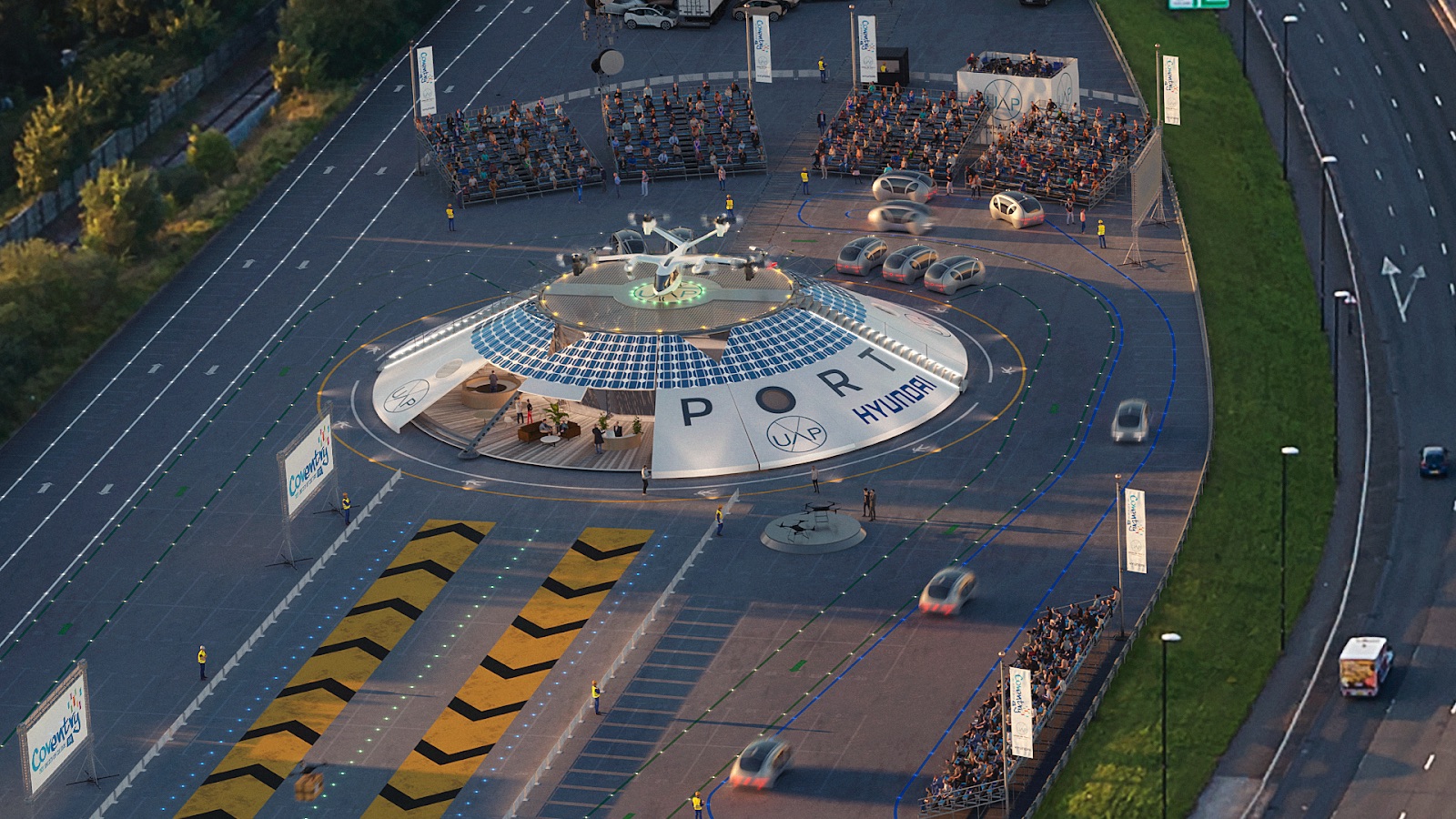
As part of efforts to reduce carbon emissions, and ease traffic congestion, The UK has launched the first flying car airport in Coventry in collaboration with several government and private entities. The project operates flying cars to facilitate people’s air mobility in urban areas as part of a project that seeks to achieve a modern mobility concept with zero carbon emissions.
City dwellers spend many hours every day navigating congested and polluted roads. This necessitated the creation of unconventional and smarter methods instead of the usual means, Among the new trends have emerged air mobility and the use of electric aircraft for short flights as an innovative and sustainable solution. According to a 2018 NASA report, The development of a field for sustainable air mobility is a viable vision, Especially with the increasing demand for the sustainable mobility vehicle market, Estimates estimate the electric taxi market at nearly $500 billion in the United States alone. Just as cars need roads, trains to railways, Flying cars need take-off and landing centers.
Towards this goal, The UK government has provided a $1.64 million grant to launch a collaboration between government agencies and private sector companies, particularly the aviation sector. Coventry City Council, Urban Airport and Hyundai Motors Group’s Urban Air Mobility Division coordinated to develop the UK’s first temporary flying taxi airport.
The implementation of this vision requires the integration of the technical and industrial aspect with a deep and comprehensive understanding of urban mobility. This emerging technology may encounter, As the NASA report noted, Significant regulatory challenges and legal constraints, Especially with regard to the weather, certification, licenses and infrastructure rehabilitation. On the other hand, Questions abound about the public’s acceptance of this technology and their willingness to rely on it. Although there are drones to transport goods, for example, There are still no flying cars or drones carrying passengers. However, studying this trend is essential to meet the challenges of climate change and plan for green and sustainable mobility.
Practically The airport will start operating in November 2021 for a period of one month, After the concerned authorities chose a suitable location for him in the city of “Coventry” in central England. This particular city was chosen because of its proximity to multiple vital centers, and the lack of a subway train in it, This makes its residents’ dependence on private cars almost total.
The airport was built to model a staging and landing centre with zero carbon emissions. This model is suitable for future mobility patterns. As for the type of flying vehicles that will be used in the first stage, Electric vertical take-off and landing vehicles have been proposed, These are known as “eVTOL compounds”. The airport will also use solar panels to generate power. In preparation for the possibility of establishing similar transport hubs in the future in locations that may lack sufficient energy supply.
Perhaps the most important feature of the flying cars that will be tested in the new airport project is their ability to take off vertically, before it moves into flight mode using its wings, In addition to its 100% dependence on electricity. The car can also carry 4 people at an altitude between 300 and 600 meters, And at a speed of up to 290 kilometers per hour.
Take-off sites can be installed and equipped in just days depending on their innovative design, It is operable and manageable completely separate from central power grids, They are powered by a hydrogen generator. This generator may produce some carbon emissions depending on the type of hydrogen used and the way it is produced. But the project implementers are working to meet this challenge by securing hydrogen from zero-emission sources. In addition, The project partners are working with the Civil Aviation Authority to allocate lanes for flying cars in the air called “highways”. The project team is also currently conducting several experiments to determine the best locations and the most suitable flying cars for the needs of the city.
Besides mitigating carbon emissions in the mobility sector, The use of vertical take-off and landing sites will have the effect of reducing congestion between urban centres, It occupies a smaller space than traditional airports.
also The flying cars used in the project offer many advantages, They are less noisy, weighty, expensive and environmentally impactful compared to helicopters. Thus it would be an option for short-distance travel in civilian spaces to relieve pressure on current congested transport lines.
Today, contacts are underway with several parties looking to benefit from this technology, From developers, private sector companies, hospitals and the military. The implementing authorities also aspire to transform flying cars from fantasy to reality, Opening the door to a clean, zero-emission urban transport system puts the UK at the forefront of new and sustainable technologies.
References:
https://www.weforum.org/agenda/2021/02/uk-first-airport-electric-flying-cars/