
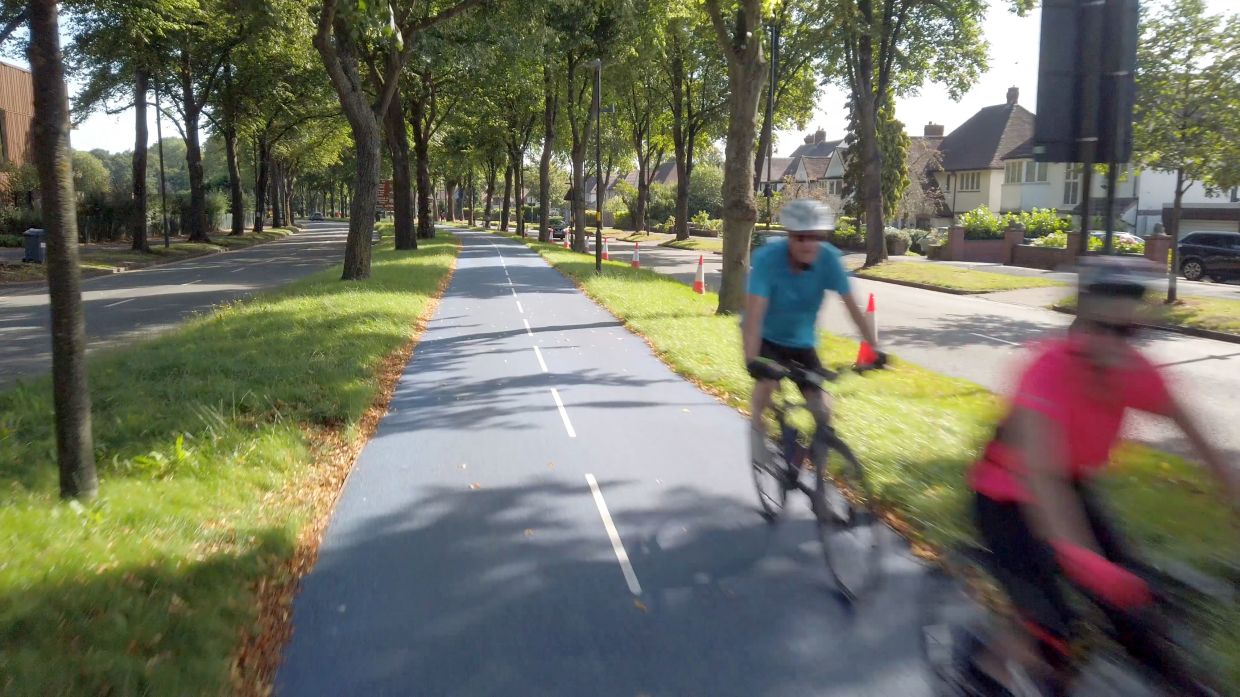
A study was recently completed in Birmingham in the United Kingdom in cooperation with the private sector, Innovative technologies built into bicycles have been used, To collect data and detect where street collisions are most frequent – or so-called “blackspots” in the field of road and transportation management.
With the increasing demand for the use of bicycles in the UK as a practical and economical means of transport, The incidence of bicycle collisions with other means of transport is high, or between them, Or with pedestrians. According to the British Department of Transport, 100 cyclists were killed and 4,333 seriously injured across the Kingdom in 2019. While the number of minor injuries among cyclists that were reported was 12,451. When taking into account minor injuries that are not normally reported, The total number of casualties may be much higher.
But with the availability of modern technologies that provide accurate and timely information about the circumstances surrounding accidents in an unprecedented manner, The Ministry of Transport conducted a study in cooperation with See.Sense, a startup specialized in bicycle technologies and data collection. In collaboration with the Royal Society for Accident Reduction (RoSPA), In order to gain a deeper understanding of the nature of the risks facing cyclists on city streets.
The “Cycle Smart Brum” study was based on a test in which a set of technologies integrated into the rear bicycle lighting device that contains sensors were used to measure the required data while the bicycle was walking and stopping. This includes data about the location of the bike, the change in its speed, drift and sudden stop, In addition to the time in which they occur, This data is then transmitted directly to a special application in the cyclist’s smartphone, The application processes it in real time using what is known as “edge computing”, which is the process of processing and analyzing data near the point where the data was collected. Thus, this technology shortens the step of sending data to a central data processor or to the cloud, Which significantly reduces response time. The application is linked to the Global Positioning System (GPS), To track the data coming from it in real time, Which ultimately leads to the formation of an accurate picture of the obstacles or accidents that the cyclist encountered anywhere on the street during his trip. This image is further complemented by the notes that the cyclist enters into the app during their journey.
Around 200 Birmingham volunteers who use bicycles daily to commute to work and relieve themselves in the downtown area took part in the test. The testing was then extended to other areas of the city where bicycles abound. The participants’ bicycles were equipped with “C.Sense” lighting devices integrated with technology. The test then lasted six months, During which these bikes covered a total distance of 42,000 kilometers, It produced billions of graph points that provide a wealth of information when analyzed to improve the safety of cyclists.
The study focused on assessing areas where collisions occur during the flight, or when avoiding a collision at the last moment, or sudden acceleration or deceleration of the bike, or its sharp deviation, In addition to the condition of the roads, and the average flight time, And the times when the bike is in a stopped state. But the most important feature of the C.Sense lighting sensors, Except for its ability to measure the speed of the bicycle and its change at every point during its path on the street, It is its ability to measure the vibrations from the contact of the wheels of the bicycle with the street with a high degree of accuracy.
Initially, this technique was used to assess the level of road quality, and determine the location and size of any gap in the street, This is done by the force of concussion caused by the gaps on the wheels of the bicycle, In order to be backfilled by the city authorities in a timely manner. But during the study, the team found that this property has greater benefits. This is because it is able to measure the force of the concussion that occurs when the cyclist brakes or when the wheels of the bike are swivel. For example, When high concussion indicators are recorded at a location on the road by a large number of participating cyclists – meaning they have pressed hard or suddenly on the brakes – it is evidence of an obstacle that poses a risk to their safety. The more severe these indicators are, The more dangerous that site is, This requires an in-depth analysis by the competent authorities to determine the nature of the obstacle and consider finding a solution to it. The study showed that the majority of these obstacles are found in crowded sites. Especially at the junction of roads and roundabouts.
At the beginning of the study, a special page was also organized on “Facebook”, Participants were able to exchange views on their experiences, And discuss the different types of problems and obstacles they faced in the streets. This page provided an additional set of qualitative data that shed more light on the problems faced by cyclists. The authors of the study also took into account the variation in leadership skills of the participants, and the impact on the results of the experiment, This necessitated the preparation of a questionnaire and test for each cyclist at the beginning of the project, A skills adjustment was developed for each of them. The qualitative data was completed by the end of the project through a questionnaire to obtain additional details and feedback from the participants.
In the end, The authors of the study confirmed its success as a tool to identify places that pose a risk to cyclists and the causes of those risks. In order to be resolved by the relevant authorities. In the end, they agreed on a key premise: solutions that reduce the number of minor collisions would contribute to reducing the number of serious collisions.
References:
https://www.rospa.com/media/documents/road-safety/Cycle-Smart-Brum-Project-Report-v2.pdf