


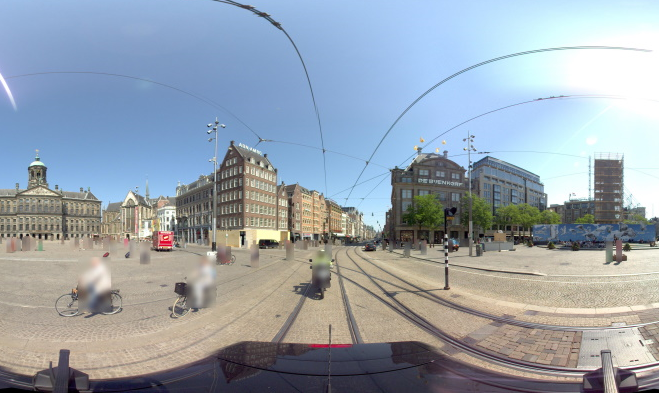
Amsterdam, a city teeming with life, is at the forefront of technological innovation aimed at safeguarding individual privacy in the digital age. The city has developed a pioneering application, dubbed “Blurring as a Service,” designed to anonymize individuals captured in public images.
The field of crowd surveillance technologies is experiencing rapid growth, playing a pivotal role in shaping urban identities and managing daily life. As with any emerging technology, these developments are not without their challenges. They raise significant concerns regarding transparency and privacy, stimulating far-reaching discussions about governance and the ethical implications of data collection within societal contexts.
Amsterdam offers a compelling case study, with its vibrant streets teeming with tourists, necessitating constant monitoring of public spaces to enhance public safety and overall quality of life.
Since 2016, the Information Department, through the Mobile Mapping team, has been capturing panoramic images of the city. These visual records serve as a digital canvas, allowing municipal employees to conduct comprehensive inspections of public spaces directly from their desks, from assessing accessibility to libraries and facilities to evaluating road conditions.
Within this context, it is evident that images capturing individuals’ faces and license plate numbers are not only unnecessary but also at odds with a city committed to citizen privacy and the deployment of responsible technology.
Critics of this type of surveillance express concerns about the erosion of privacy in public spaces and the potential misuse of collected data. These concerns range from the deployment of facial recognition technology and comprehensive surveillance to the profiling of individuals and the exposure of their sensitive personal information, ultimately paving the way for identity theft or discriminatory practices.
The challenge is that none of the existing technological solutions have managed to achieve the balance Amsterdam is seeking: to cover vast areas accurately and comprehensively, without compromising on the highest ethical standards. This has prompted the municipality’s technical team to launch an innovation supported by the latest artificial intelligence technologies, dubbed the “Blurring as a Service (BaaS)” program.
Blurring software typically works by obscuring facial features, making it difficult to identify individuals appearing in surveillance footage or panoramic shots collected around the clock in major cities. However, Amsterdam’s municipality has decided to take it a step further, blurring the entire body as well as license plates, ensuring that any individual in any panoramic image is completely anonymous.
The innovation has multiple uses and incorporates a large amount of data. It was developed by the Computer Vision team within the municipality itself.
However, wouldn’t excessive blurring compromise the primary function of panoramic surveillance footage? Herein lies the challenge of finding the right balance between images that don’t reveal individuals but provide authorities with enough detail to efficiently deliver public services, whether it’s assessing road conditions or improving accessibility.
This is not the only challenge. There’s also the issue of bias introduced by machine learning algorithms. These algorithms, despite their potential, can inadvertently perpetuate the biases present in the training data they are fed. In fact, Amsterdam has chosen to address this challenge by integrating an inclusivity feature, ensuring that blurring takes into account various physical attributes that may distinguish one group from another. This helps in treating unintended biases that creep into the anonymization process.
Furthermore, there is a challenge that all endeavours to use AI applications in public service face which is ensuring transparency and building trust. There is a successful approach to this challenge: clear communication with the public to explain the purpose of the program, how it is used, and how it is developed.
Amsterdam has an ‘AI Register,’ a groundbreaking municipal initiative launched by the city’s authorities in the fall of 2020. This register aims to ensure transparency and accountability in the government’s use of artificial intelligence systems.
The record detailed how algorithms influence daily life, from traffic to public services, explaining the data used to power these systems.
Amsterdam’s pioneering experience has shown that technology is not merely a functional tool but also a means of safeguarding individual freedoms and privacy. The city has used technology to simplify its services, protect its citizens, and empower them with knowledge. Furthermore, Amsterdam has opened the door for its citizens to become active participants and potential contributors in the ongoing dialogue about the development of artificial intelligence through its record.
This innovation has highlighted the paramount importance of ethical practices and the consideration of inclusivity, justice, and transparency in all aspects of public service.
References: