

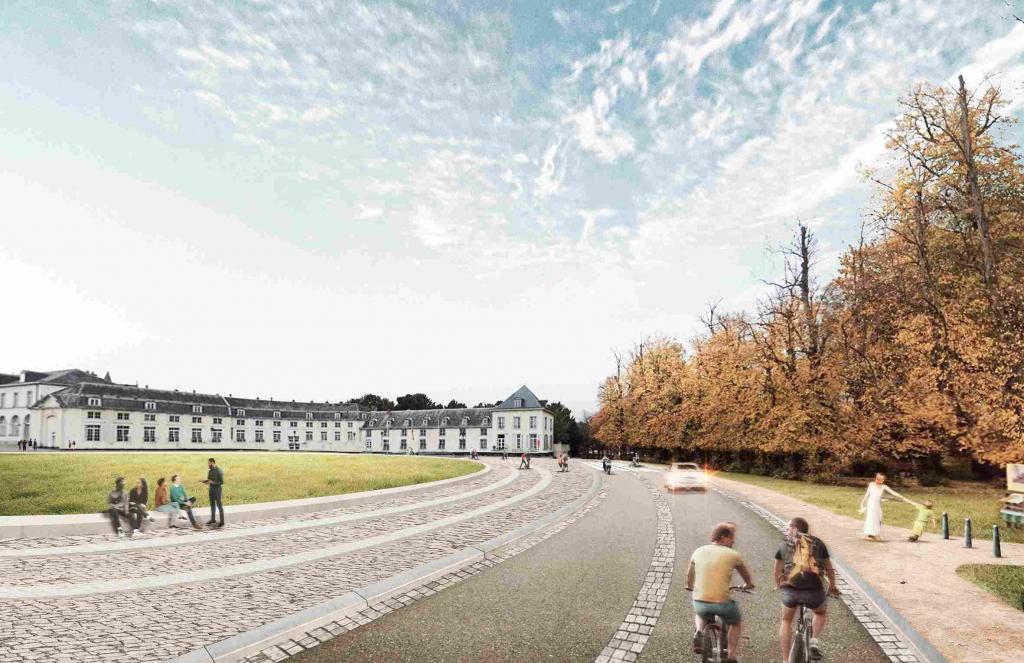
In response to the popularity of bicycles in major European cities, The governments of Germany, the Netherlands, Belgium and Austria are working on bicycle highways. to offer its citizens more comfortable and safe experiences, and reduce greenhouse gas emissions, It makes the concept of active mobility more attractive to everyone.
Recent years have witnessed a great demand for the use of bicycles, People are starting to realize that cities can’t continue to grow to accommodate more cars. The environment will not be able to withstand its impact. Realizing that paved the way for the “European Bicycle Boom”.
Besides environmental considerations, Many factors contributed to the occurrence of this phenomenon, Most notably the COVID-19 pandemic, When its spread peaked in 2020, Millions of Europeans have refrained from using public transport and relying on bicycles. Less than two years later, It came the energy crisis and high fuel prices that prompted a few million others to abandon their cars and replace them with bicycles.
But the aspirations for a vibrant economy, healthier and happier citizens and a cleaner environment, will not be complete on traditional roads where all means of transport are crowded, Investment in safe and connected infrastructure for cyclists is essential. And streets with modern designs capable of accommodating their growing numbers.
Right this way The idea of “bicycle highways” was born, which can be defined as high-quality career paths for bicycles only, Connecting people to vital points or connecting residential and commercial areas, So that it is a network of secondary roads that meet in a main line.
The Netherlands hosted the first European experiments, It has developed its National Cycling Strategy since 1990. Since then, it has established several cycle paths covering more than 35,000 kilometers today. This is a significant number given the length of the country’s road network. Which does not exceed 140 thousand kilometers. In other ways, Priority is given to bicycles at the expense of cars, Banners with the words “Cars are guests here” are distributed to underscore this idea.
The Regen-Walbad road is one of the most prominent Dutch bicycle routes. It was inaugurated by the municipalities of the two major cities in cooperation with the national and regional governments. The road extends for 17 kilometers, It is interspersed with two tunnels and a bridge and surrounded by gardens, Its budget amounted to 17 million euros.
German society has also established a strong relationship with bicycles over many decades. As the government tries to meet its climate change commitments, Several initiatives have been launched to improve the bicycle road network, In Berlin, A 38-kilometer road has begun to be built connecting the eastern and western ends of the city and providing direct access to about 513,000 people. The feasibility study suggests that a cyclist will need two and a half hours to cross the entire road at medium speed. In Hamburg, The local government shall establish a road connecting it to its neighbour, It will have a large carrying capacity and a width of approximately 4 meters. In Munich, Citizens have called on the authorities to expand the bicycle infrastructure. Following the feasibility study, The city responded to their request by announcing the construction of 6 bicycle highways in addition to a ring road around the city center, The first route will start from the heart of Munich to cover a distance of 9 kilometers, 2.3 meters wide, The project will be completed in 2025.
In the same year, Belgium will put the final touches on the new cycle route that will connect the city of Leuven in Flinders to Brussels. The capital of the country, To meet the needs of citizens who live in the first and work in the second.
Austria was also one of the countries that chose to expand the active transport system. The capital authorities recently announced the launch of a two-year project to extend the first bicycle highway. It will be 7 kilometers long and 4 meters wide, Surrounded by greenery with signs bearing the slogan “Abandon the asphalt”. The route was chosen based on last year’s statistics that 1.3 million people crossed it. It is also convenient for installing hydroponic systems for air cooling. This project comes as part of the “Climate Smart City Strategy”, that will work to secure a high quality of life, conservation of resources, emission reduction, And approach social issues in a way that ensures equitable access to climate neutrality.
Because these projects target infrastructure and redesign cities, It needs more space and huge funding. What may burden governments, It will also require special parking, traffic lights and road conditions to cope with extreme weather conditions that impede bicycle movement and cause slips and accidents.
The Austrian project will contribute to the mitigation of the phenomenon of heat islands and greenhouse gas emissions, The Dutch Ministry of Transport and Public Works and Water Management aspire to boost the use of bicycles and prevent traffic jams. In turn, The Belgian project aims to provide more comfortable and safe trips between one city and another, Not within the town itself.
As for Germany, She was able to formulate her aspirations in numbers, It estimates that the capital road will attract 7,000 new cyclists and save about a thousand tons of carbon dioxide emissions annually. It offers an alternative to traditional means of transport.
References:
https://www.themayor.eu/en/a/view/vienna-is-building-its-first-cycling-mega-highway-9885
https://ecf.com/news-and-events/news/new-survey-people-cycle-most-where-they-feel-its-safe
https://www.themayor.eu/en/a/view/munich-if-you-sow-cycle-highways-you-reap-cyclists-10444
https://www.themayor.eu/en/a/view/brussels-to-leuven-cycling-highway-ready-in-2025-11031