
In order to cope with the consequences of natural disasters in one of the most vulnerable parts of the world, The Government of Bangladesh is building resilience through a digital platform that provides data on climate events, assesses risks and guides stakeholders to action.
Natural disasters do not exclude a country in the world, Although their intensity and frequency may vary from one spot to another as a result of geographical data and the effects of climate change, However, they cause enormous loss of life, property, the environment and infrastructure. While humans cannot prevent disaster, They can prepare to contain its effects.
Asia is hit by the largest share of natural disasters. In Bangladesh, Dozens of tropical cyclones follow annually, Perhaps the most famous is Cyclone Paula, which killed more than half a million people, the majority of whom were women who were afraid to leave their homes or go to shelters.
When the pointed Bay of Bengal is hit by cyclones, floods occur and destroy coastal areas, The last of which was a flood that is the worst, It happened more than 100 years ago, More than 7 million Bangladeshis have been displaced. Complicating matters further is the scarcity of resources. The Bangladeshi country is low-income and lacks the luxury of launching mega projects. So, Over the past years, her government has developed a system to increase flexibility with relatively few resources. However, it has had difficulty integrating disaster protection into all stages of development planning. In particular, the databases related to it are scattered and random and do not provide the information necessary for the development of disaster prevention programmes, Rather, it focuses on budget management and monitoring, Even the accompanying risk assessment tools focus on physical and visible risks, It lacks an integrated approach that examines weaknesses at multiple levels.
To change the scenery, The government found the solution in early warning systems that warn authorities and residents of the approaching disaster. It gives them valuable time to take protective action, This is in line with the UN plan to protect “every human being on earth”.
The multilateral project was the result of the support of several parties, Funding was raised with the contribution of both the official Bangladeshi government, the Office of Foreign Affairs and Development of the Government of the United Kingdom, The Swedish Government’s International Development Cooperation Agency, The project was implemented by the National Resilience Building Program with technical support from the United Nations Development Programme (UNDP).
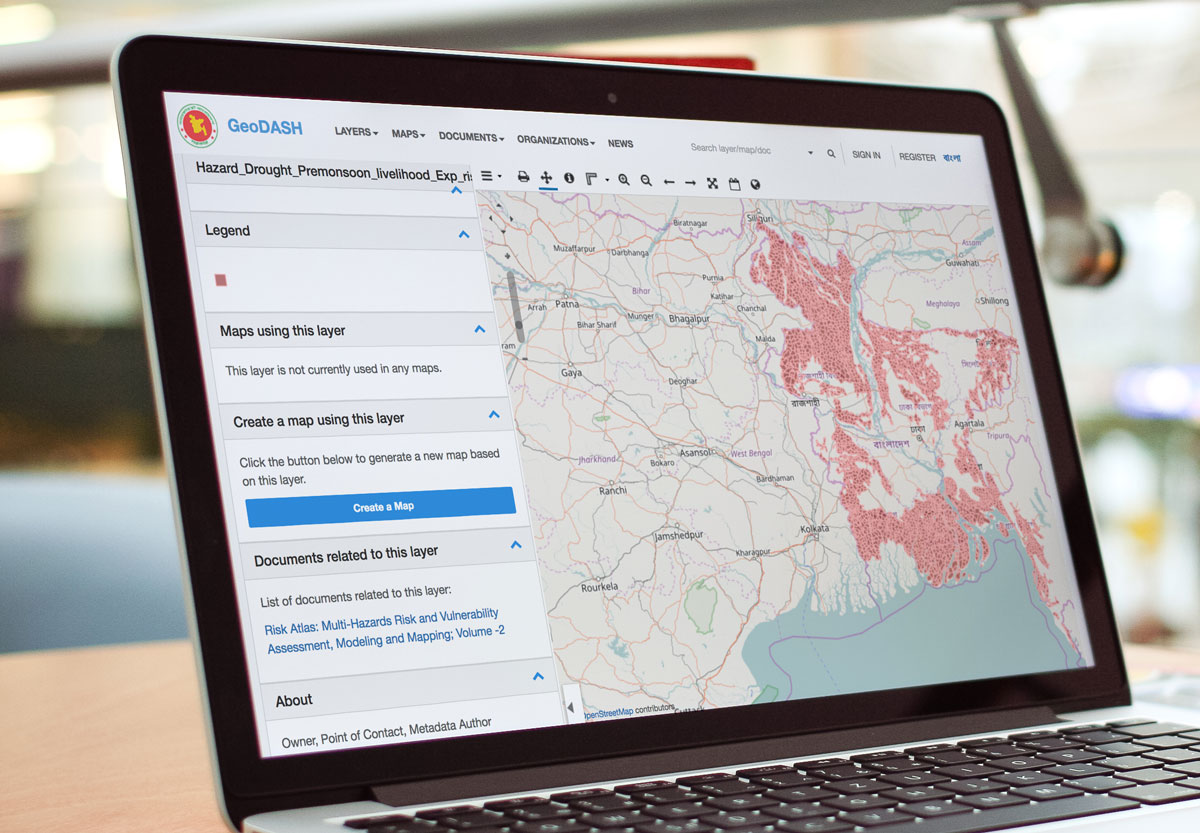
Partners launched the “Disaster and Climate Risk Information Platform” project, It is an electronic portal that includes all information related to disasters and weather phenomena, No matter how small or large, To enable risk assessment, vulnerability and containment of their impacts. The platform focuses on 11 phenomena, including floods, salinization, landslides and earthquakes, It covers 64 Bengali provinces, It provides the planning and investment tools necessary to budget development projects for all regions of Bengali.
The platform allows the user to view a map of the entire geography of Bengali, and choose the information he is looking for, Such as potential disasters such as hurricanes, droughts, floods, landslides or rising sea levels, Then inform him of the expected severity of the phenomenon and the effects it will cause on infrastructure, population and land, It also allows multi-layered maps and detailed spreadsheets. As for government employees, They have special passwords that allow certain sets of data and narrative reports to be downloaded.
For decades, Bangladesh has stepped up its investments in forecasting technologies for weather phenomena and natural disasters. Resilience building projects, Training government and volunteer staff to provide relief to the population in the event of a disaster. In half a century, The forecasting system has grown from two coastal radars 320 km from the coast to a comprehensive network of dedicated stations including coastal, ground and drone-mounted radars, All collect live data and share it with residents and local authorities, And at a higher level, with the governments of the 193 member states of the World Meteorological Organization, In accordance with a recent decision by the Organization to enable the free exchange of data, so that distant predictions and diverse data are accessible to all, This is an essential advantage when it comes to tropical cyclones that can start at geographically distant points before extending and expanding to the Bay of Bengal.
While these solutions provide the data needed to protect people, Getting it to them remains a challenge, The Government therefore resorts to television and radio broadcasts, text messages and a hotline, which broadcasts pre-recorded voice messages containing an update on the current situation and guidance on the necessary actions. The “last mile” challenge of reaching all people, no matter how remote they are, The Bangladesh Red Crescent is confronted with 76,000 volunteers distributed by the Ministry of Disaster Management and Relief in the country’s squares and central markets. They explain to people the severity of the storms ahead, They then roam the streets on foot or on bicycles with loudspeakers to deliver the warning to the most vulnerable. Such as illiterate or elderly.
In preparation for the future, The government has launched a “learning through play” program in some of its high schools. School administrations conduct trainings to teach children how to deal with disasters and provide first aid.
This project will provide Bangladeshi policymakers with a knowledge platform to design future plans. It will provide a unified and reliable source of information.
After 50 years during which the number of victims of natural disasters has fallen from half a million to 26 people, Bridging the gender gap in disaster response, Bangladesh has been able to establish an effective disaster management system with the help of countries and organizations with minimal resources, To establish a model for other low-income countries that need to develop early warning systems in the face of natural disasters and the effects of climate change.
References:
https://www.bbc.com/future/article/20220719-how-bangladesh-system-fights-cyclones-climate-disasters