
Autonomous vehicles seem to be the future of transportation. Conviction reached by several Asian countries, most notably South Korea, China and Japan, Each is working hard to change the shape of the transport ecosystem by experimenting, legislating and developing technologies.
Smart technology is changing life standards, It dictates people’s livelihoods, mobility, work and relationship with those around them. and on the roads, This technology has given a new understanding of transportation, From helping the driver drive to replacing him completely.
The concept of self-driving vehicles is relatively new, But it is known to all, These vehicles can sense the surrounding environment and move without human intervention. Or minimally thereof. It is now divided into 3 main categories, These are private and shared cars (i.e. taxis) and buses. however In fact, A public transport system that relies entirely on self-driving buses may not be without excess, It means putting lives in the hands of a technology that has not yet been completed, It is still unable to adapt to different traffic conditions, The required safety standards have not yet been met, Not to mention the costly infrastructure it needs and the qualified labor force that will lose its jobs if the machine replaces it.
But the positive environmental impact that this dream will achieve, if realized, is worth trying. Of course, after meeting at least the three main conditions, They are the technique, the regulatory framework and the acceptance of the people. Towards this goal, Many governments have begun experimenting to test and develop the concept.
Starting with the pioneer, South Korea Seoul’s metropolitan government has launched the first small-scale self-driving commercial bus service. The trip will be limited to about 3.5 kilometers, during which it will stop at two stations and not carry more than 7 passengers who can reserve their seats through a smart application. The bus will move, which will carry passengers free of charge during the first period, At low speed within a busy tourist and commercial area in the city center.
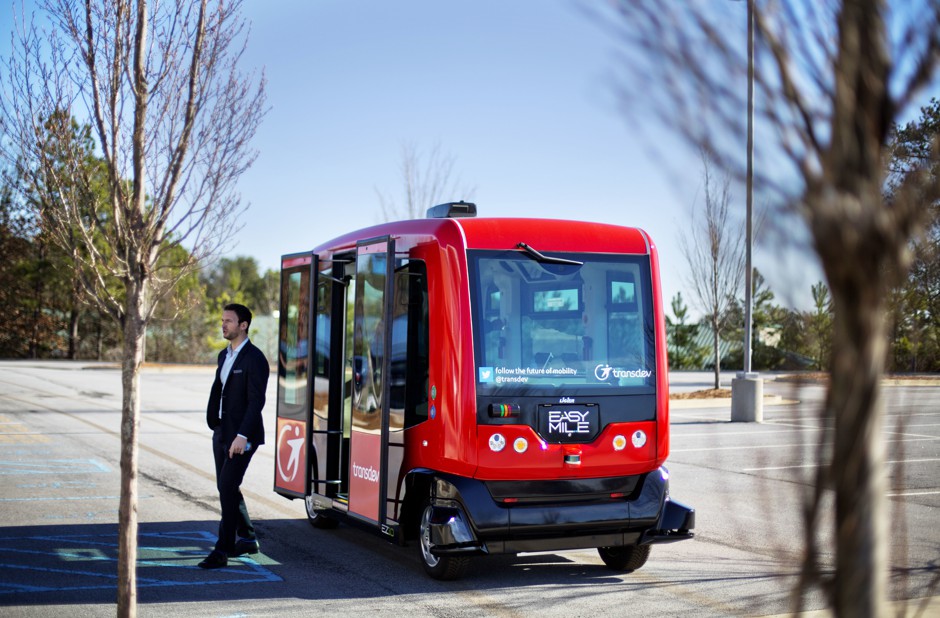
These buses achieve the fourth level of autonomous driving, That is, its software can take over. But for safety, The driver will remain there to take over the driving in busy parts where pedestrians, trucks and motorcycles are spreading. The bus includes 12 cameras and 6 sensors that study road conditions and traffic signs. It offers a tourist experience through large windows and a sunroof that allows passengers to enjoy the sights of the city.
With a budget of nearly $900 million, Korea is urging its public and private sectors to achieve its ambition to deploy autonomous vehicles on all its roads by 2026. Among them are 400 buses and taxis.
As for the second experiment, It was in China, whose government was making strenuous efforts to cooperate with the private sector and innovators and encourage consumers. The focus of China’s Ministry of Transport is on policy formulation and national guidelines. Its first criterion of success is safety and an organized environment. Having allowed dozens of buses, delivery cars and the first fully self-driving taxi, It now plans to deploy self-driving buses on its own closed roads, Allow taxis to operate on safer and more controlled streets.
Recently The Chinese government has amended the traffic safety law, It sets mandatory standards for vehicles on highways and on streets chosen by the local government. Perhaps the most important thing provided by the new legislation is to determine responsibility for traffic violations and accidents if these vehicles are a party to them. The latter are equipped with live surveillance systems and are capable of recording data for at least a minute and a half before an accident or system failure. This feature is a condition for granting a test permit.
Some cities also added other details according to their specificity, As Chongqing City, which does not allow buses to move without a safe driver, It has established a command center that receives information from sensors and cameras distributed across the city to ensure that the system runs as best as possible. Guangzhou, for example, It stipulated that the passengers of public buses must be adults and have civilized behavior, It is preparing to deploy 260 self-driving vehicles on its public roads before the end of this year. In its pilot projects, it tries to cover several areas such as freight, freight transport, logistics, container transport in ports, and others.
This experience is similar to that witnessed at the airport in the Japanese capital, After 4 years of preparations, Level IV self-driving buses will begin transporting passengers within the airport facility, Supported by a network of cameras, sensors and tracking devices, And on lengthy trials of different types of autonomous vehicles traveled about 130,000 kilometers without any incident, The final choice will be made on a 14-passenger bus, It uses GPS and a backup system that regularly scans the road ahead of the bus to take over the drive in case the main system fails. This bus will join 4 cars patrolling the airport perimeter and 12 trolleybuses pulling luggage containers. All of which are battery-powered, It is hoped that its number will double to take over all ground operations by 2030.
All these ambitions seem far away, Measured by the high costs of infrastructure and vehicles themselves, the associated security risks and the many jobs that will eliminate them.
The availability of technology and regulatory framework remains insufficient unless people widely accept this shift. This will be achieved at an advanced stage as the number of these vehicles increases, the technologies they operate evolve and they overcome technical challenges in order for people to be convinced of their benefits.
In the long run, Self-driving buses will upgrade the transport system, Especially in major cities and cosmopolitan areas, It can facilitate public transport, make it safer, and reduce congestion and emissions, What could really make it the future of transportation.
References:
https://www.chinadaily.com.cn/a/202209/28/WS63340a01a310fd2b29e7a426_1.html