
Hundreds of lifeguards are collaborating to ensure safety on Japan’s beaches. It faces a serious danger represented by rip currents that are difficult to detect with the naked eye. Therefore, An artificial intelligence system has been developed and linked to cameras spread along its shores, Monitoring spatial data and human movement, To prevent accidents, speed up response and save lives.
The term “pulling wave” is commonly used among people as a name for a phenomenon occurring in the oceans. But the truth is that it’s not a wave, It is a narrow current that accompanies the waves, He carries what gets in his way away from the shore and takes him back to the sea at speeds beyond Olympic swimmers. A phenomenon that scientists are making great efforts to understand and learn more about.
What science has found so far is that this current, which is often difficult to see, It does not necessarily need large waves or bad weather. It also poses a great danger, and even deadly, On beachgoers, It carries swimmers away from the shore at a speed that is irresistible.
The Lifesaving Association of Japan notes that each season rescuers successfully resuscitate 2,000 to 3,000 unconscious people while swimming. As a result of accidents, natural phenomena, fatigue, inability to continue swimming, strong winds, etc.
In fact, 45% of these cases are swimmers carried away by pulling currents. Their rescue depends largely on the time factor, Especially in the case of cardiopulmonary arrest, It is impossible to save the injured person 3 to 4 minutes after the occurrence.
Controlling natural factors or stripping them of their properties or hazards may be beyond human control, But what the authorities can do is avoid them or contain their effects. This is exactly what the Japanese authorities are striving for, She tries to make use of what he donated most to save her most precious asset. To put it simpler, It tries to employ technology to enhance the safety of its citizens from swimmers and beachgoers and protect them from the rip currents.
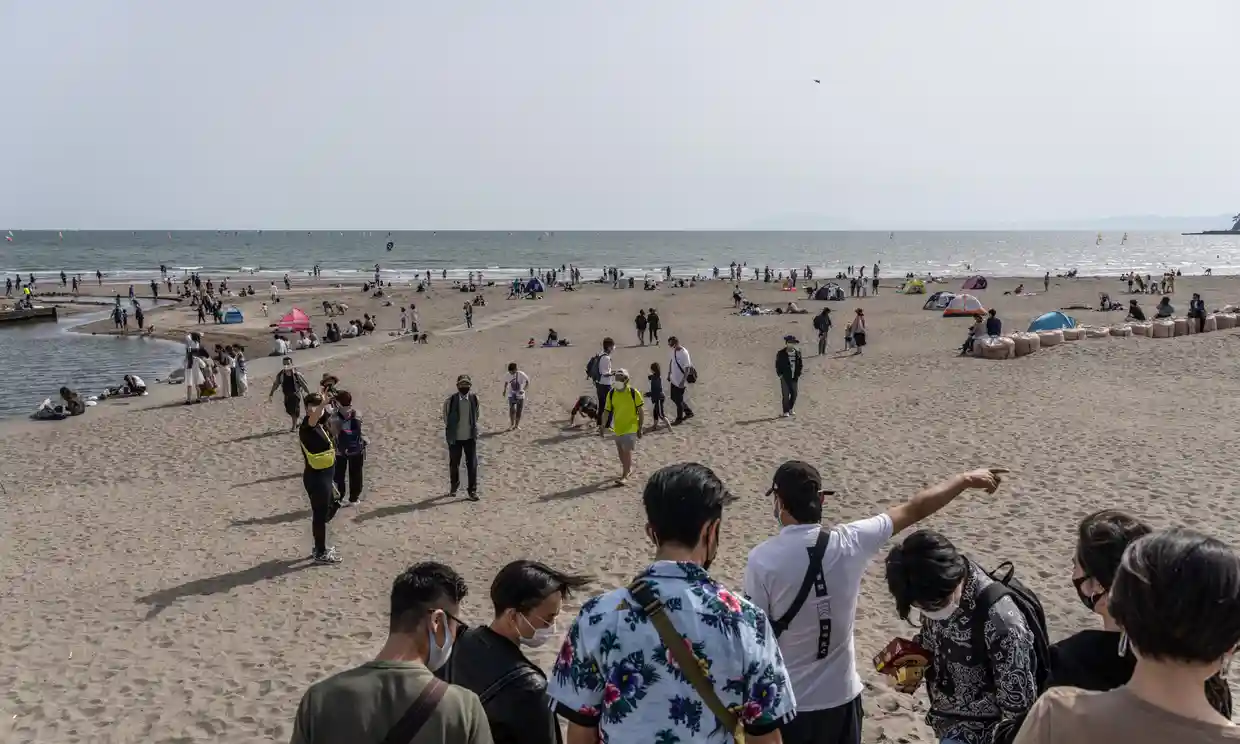
Like this Kanagawa City, south of Tokyo, began, Experience using artificial intelligence to monitor rip currents and alert swimmers and lifeguards alike, On a popular beach crowded with surfers that reopened after two years of closure due to the COVID-19 pandemic.
The system uses artificial intelligence and the Internet of Things, It consists of a software component integrated with equipment installed on site, It is a camera connected to the Internet and mounted on poles within the swimming area, Along with smart watches worn by lifeguards. Wideband cameras have been selected, As soon as you spot a pulling stream or anyone swimming or surfing nearby, You send an online notification that the rescuer receives on land to intervene to pull the person at risk towards the shore.
To enable the system to identify the phenomenon and monitor risks, Developer teams at the Rescue Society and Capital University collected heavy data during the winter of 2021. Through this data, A deep learning model has been created and algorithms have been created that the system will rely on in identifying risks.
The images taken confirmed the presence of rip currents, including intermittent and overlapping ones, It appeared as a gray line crossing the wave range that usually appears in white. To verify the results further, Developers resorted to using a redundancy detection model, They wait for a puller stream to start taking pictures at a rate of two or three photos per second. These images are collected every 20 minutes, They are then analyzed after calculating the wave’s speed, direction, altitude and other basic data.
But Japan is not alone in this endeavor, but participation in a race involving many countries facing the same danger, Like the United States of America, whose government is working on launching a smart model that can predict ripple currents 6 days before they occur.
Achieving absolute trust in AI systems can be a major challenge. It may not be fully reliable, Additional means such as raising awareness of safety measures and wearing life jackets are needed. It is worth noting that these jackets, although they ensure buoyancy and achieve great effectiveness in protecting against drowning, They may generate a false sense of security, Swimmers are disrupted by the dangers that they will have to face – in many cases – themselves will have to address.
Despite the uncertainties surrounding these technological solutions, The intelligent system developed in Japan has proven to be very effective in preventing accidents associated with ripple currents. The system was able to detect these currents with an accuracy of 91.1%. Its ability to monitor human presence within the current range was 96.5% accurate. This means shortening half the time needed for rescue, And make the beach experience smoother, It is a healthy, educational experience that can improve the quality of life if adopted as a regular activity that takes place in a safe environment.
References:
- https://www.theguardian.com/world/2022/jul/05/japan-deploys-artificial-intelligence-to-detect-rip-currents-as-beach-season-hots-up
- https://yab.yomiuri.co.jp/adv/chuo/dy/research/20190808.php
- https://mainichi.jp/english/articles/20220702/p2a/00m/0na/028000c
- https://education.nationalgeographic.org/resource/rip-current
- https://oceanservice.noaa.gov/news/apr21/rip-current-forecast.html