
Because the quality of roads is a major factor in the safety of their users, several countries, such as the United Kingdom and Lithuania, have started using advanced technologies to make road inspections and maintenance easier and more efficient. Drones, artificial intelligence, sensors, and modern high-resolution cameras that can cover hundreds of thousands of kilometres and reach where humans fail are the most prominent of these technologies.
Every day, nearly 4,000 people die in traffic accidents around the world, on roads shared by cars, buses, trucks, bicycles, motorcycles, pedestrians and others.
Many factors cause these accidents, starting with human errors – which are the most common – to weather conditions such as wind, frost or fog. While humans and weather factors are considered relatively out of control, it remains possible to maintain a certain quality of the road network and protect it even from the first two factors, as this vital infrastructure is highly vulnerable to traffic, weather, acts of vandalism, and others.
All this leads to the formation of potholes, cracks, or road erosion that may take some time to appear, and when they do, they cause bigger problems, longer traffic disruption, higher cost of repairs, and a general state of insecurity, not to mention the accumulation of rainwater, as in the case of Australia, which most regional roads were built in the aftermath of World War II, and were followed by heavy traffic conditions and severe weather.
To avoid all these repercussions, early detection of such problems is necessary. And because it is not visible to the naked eye, then it should be discovered by experts, or wait for them to worsen and people complain about them.
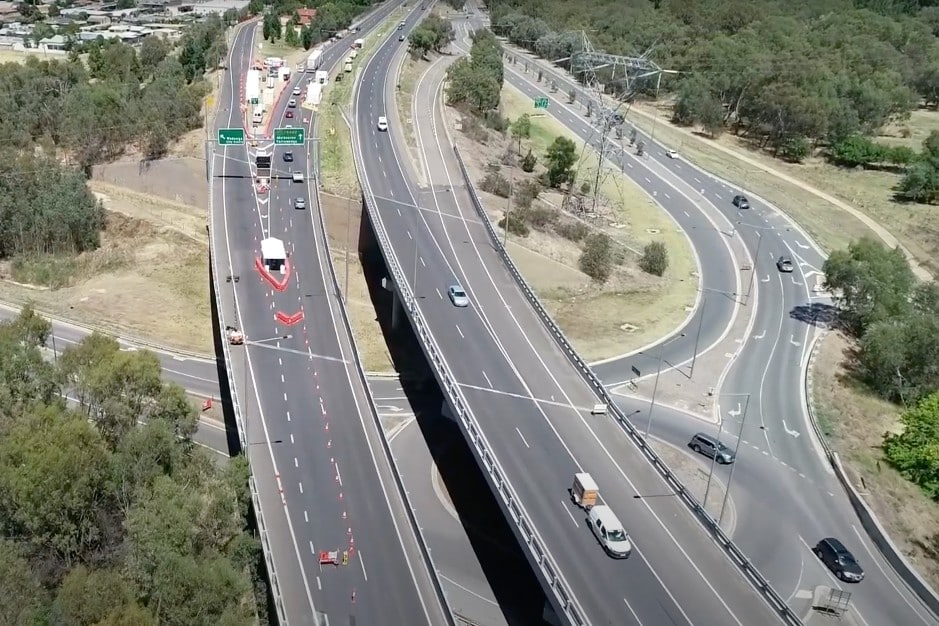
Drone-mounted high-resolution cameras, sensors and artificial intelligence (AI) software are part of what the Victorian Government is calling a “regional road maintenance blitz” to renovate its transport network.
The trial of the AI software “EaglEye” is underway in the state’s north east, helping to map and assess the condition of more than 4,000 kilometres of arterial roads and roadside assets. The software has used footage captured by vehicle-mounted cameras to automatically detect, categorise, and assess the condition of hundreds of thousands individual road assets, including signs, line marking, trees, and safety barriers, as well as the road surface itself.
In most places, the state level Department of Transportation oversees the maintenance of major roads. But the maintenance of smaller roads, like town roads or roads that go through neighbourhoods, is usually left to local municipalities. To do so, employees temporarily have to shut down a section of the road and photograph it while walking along on foot, during which they take pictures for experts to review, as part of a slow, expensive, arduous and inaccurate process that is not sufficient to collect the necessary data and is only conducted once a year, as no city can afford to close its roads any longer.
Today, many governments are unable to provide systematic maintenance of roads by traditional means, and it is natural to turn attention to today’s technology solutions. The idea is to exploit drones’ ability to reach locations that are difficult for humans to reach, such as under bridges, busy highways and storm barriers, as well as areas hit by storms or fires to gather as much information as possible and assist with planning for clean-up and repair works.
City leaders in Winchester, Virginia, wanted to test whether drones could collect visual data reflecting the pavement conditions. This initiative is part of DroneUp’s Innovative Municipalities Project in Winchester and the goal was to see if a drone could be used to collect all of the visual data the city needed for its pavement inspections. Beyond just taking photos, the DroneUp team wanted to use this data to create detailed 3D models of the street that would show the condition of the pavement.
In Europe, the government of Lithuania is undergoing a similar experiment in cooperation with private sector partners. Lithuania wants to deploy drones equipped with high-definition cameras and multiple sensors to perform the inspections, whether it’s with a monthly, weekly, or even daily frequency. The result is a jointly developed project called GreenBee, whose purpose is to improve the whole process of inspection and reduce the CO2 emissions associated with it.
These technologies save taxpayers money and keep workers safe, and will enable inspection and maintenance teams to map thousands of kilometres accurately and comprehensively within weeks, replacing traditional processes that may take more than 3 years.
These processes will also help officials build a deep understanding of the state of the road network, direct funding and resources according to real needs, and reduce carbon footprint and emissions, which are in the service of the climate change agenda.
References:
- https://www.abc.net.au/news/2021-11-17/caravanning-crash-reignites-debate-over-country-victorian-roads/100626358
- https://roadsonline.com.au/victoria-trials-ai-drone-tech-for-road-maintenance/
- https://doav.virginia.gov/calendar-and-news/news/2021-september/drone-testing-in-the-skies-over-winchester-va-is-just-plain-smart/
- https://www.droneup.com/2021/11/23/can-drones-help-cities-fix-potholes
- https://www.autoevolution.com/news/lithuania-plans-to-automatize-road-inspections-will-switch-to-pothole-detecting-drones-182157.html
- https://agmis.com/ai-and-uavs-to-monitor-lithuanian-road-infrastructure/
- https://theconversation.com/suddenly-dodging-potholes-after-all-this-rain-heres-how-drones-could-help-with-repairs-191077