
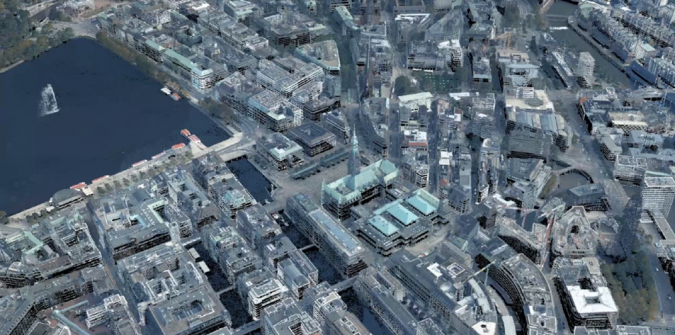
In its search for additional comprehensive vision to support decision-making, Germany has embarked on the development of a national digital twin with data from all available sources to return to it in developing plans, strategies, predicting obstacles, and supporting its path to become one of the smartest countries digitally.
Leading a country is extremely complex, especially in this era, where challenges are intertwined and people’s demands are becoming more difficult and complex, and even in the most prosperous and democratic countries, decision-makers may sometimes find themselves unable to make optimal choices.
It may be surprising that this applies to a country like Germany, which for decades has been among the countries with the strongest economies, most successful education systems, highest safety rates, and best health services. But Germany’s global reputation did not come in vain, as the government was constantly working to approach social, environmental and economic challenges, such as the increasing use of land, rising energy demands, extreme weather, limited natural resources, and sociodemographic changes.
The German Federal Agency for Cartography and Geodesy (BKG) is creating a digital twin in order to make decisions within government entities based on a common, clear and comprehensive basis in terms of data.
This digital replica of Germany will be built as an intelligent 3D world containing all the essential geospatial objects, enabling the relevant processes to be mapped holistically and in relation to each other based on a common data foundation collected using IoT devices such as sensors, video cameras, etc.
A digital twin of the whole of Germany that can be used by researchers, planners and policymakers to simulate various future scenarios to adequately address societal challenges.
The teams will create a digital twin for the whole of Germany in an unprecedentedly consistent, dynamic, complex and detailed manner, with all the essential geospatial objects, accurate topographic information, big data analytics, modern visualization techniques, satellite data, and a very large number of scientific projects and feasibility studies, in order to illustrate interrelated challenges and their intersections.
The twins include hydrologically sound models to simulate flash flooding due to heavy rainfall, to urban climate analysis which requires information about the height of buildings in order to model air flows.
Large-scale Lidar is an accurate data collection method for the canopy height and density of trees in a forest. The data can then be used in biogeochemical models to estimate carbon capture.
To capture an area as large as Germany in a timely manner, conventional Lidar methods are not sufficient. Instead, state-of-the-art capturing techniques are required such as Geiger-mode Lidar (GmL) or single photon Lidar (SPL). Like conventional or linear Lidar, both these methods rely on the time-of-flight measurement method: the travel time difference between the emitted laser impulse and the detection impact of the reflected echo.
The technologies were a key part of the Hamburg City Survey project, which covered nearly 9,000 square kilometres. This pilot project was launched by the State Office for Geoinformation and Surveying to explore technologies and validate data. The result was a three-dimensional model of the entire surface area, in which all relevant objects are recognisable: buildings, rooftops, power lines, trees, etc. It is equipped with intelligent algorithms that can recognize and tag these common objects.
When completed, the model can be consulted before decisions are made, providing a framework of shared data to come up with solutions to challenges to contain their impacts. Data will be shared across the entire country and updated regularly, so policymakers can monitor different circumstances. For example, the federal administration adopts a nationwide environmental monitoring system that includes details about precision agriculture, water management, air pollution and climate change.
Digital twins have long been a reliable tool in industrial production to mirror processes in their entirety. Transferring this concept to a wider geographical scope, such as an entire country, poses challenges ranging from technological scaling and modelling to information management and data integration. However, recent advancements in information technology – such as increased processing capabilities through cloud computing, artificial intelligence, and improved surveying techniques – now put the prospect of a nationwide digital twin within reach.
The German federal government will start working on this project in 2023 with the European Commission, which in turn has launched an initiative, Destination Earth (DestinE), to create a digital twin for the entire earth over the next decade. A common data foundation will enable decision-makers to make faster, more informed and reliable decisions and, most importantly, create communication channels for stakeholders at both the federal and national levels.
At the level of countries in general, and a country such as Germany in particular, these technologies play an essential role in improving infrastructure, emergency readiness, conducting research and developing strategies.
Digital twins open up broad horizons for future smart cities; helping them to fulfil their tasks in a more environmentally, economically and socially compatible way.
References
- https://www.gim-international.com/content/article/building-a-digital-twin-for-germany
- https://hxgnspotlight.com/germanys-digital-twin-smart-digital-realities-can-help-solve-germanys-pressing-challenges/
- https://digital-strategy.ec.europa.eu/en/policies/destination-earth
- https://commission.europa.eu/strategy-and-policy/priorities-2019-2024/european-green-deal_en