
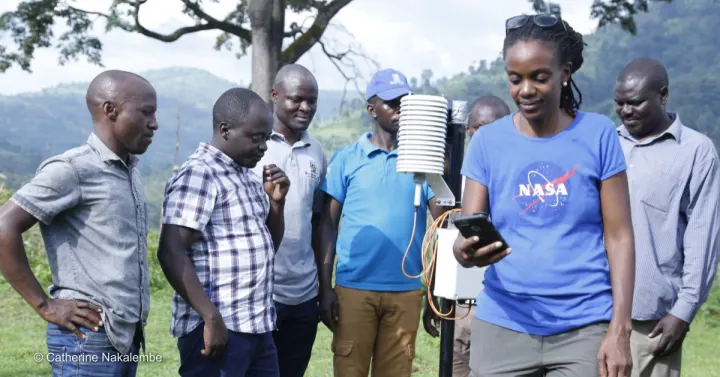
In the face of escalating climate, food, and demographic challenges, NASA’s Harvest Africa program has launched a project aimed at improving agricultural practices through the utilization of real-time data and satellite imagery.
In an era marked by rapid technological advancements and a rapidly changing world, modern technologies are driving transformations across various sectors. These technologies not only promise to enhance efficiency and productivity but also to address longstanding challenges faced by certain industries.
One sector demanding particular attention is agriculture, which has been disproportionately affected by climate change. In a continent like Africa, with its unique environment and population, field productivity and crop quality are declining. Farmers in countries like Uganda face significant challenges in adapting to climatic phenomena such as irregular rainfall, soil degradation, and rising temperatures. These challenges have led to resource scarcity, reduced crop yields, and made it difficult for farmers to maintain even a minimal livelihood, placing the continent in a relentless pursuit of food security.
In light of these circumstances, NASA’s Harvest Africa program, through its scientists and researchers, is continuously working to find solutions and develop programs. Through partnerships with local organizations, research institutions, and private companies, the program has launched its latest initiative, “Helmets Labelling Crops.”
This program relies on remote sensing technology and satellite imagery. Scientists use this data to assess the health of vegetation. Satellites orbit the Earth around the clock at various wavelengths, collecting vast amounts of data. By collecting, sorting, and analysing this data, researchers can identify different types of vegetation, assess crop yields, and even detect threats, pests, or diseases.
The effectiveness of satellite data relies on accurate real-world data to develop machine learning algorithms capable of analysing it. To this end, NASA has adopted an innovative approach. Unlike traditional methods of collecting images through the deployment of specialized teams, which is time-consuming and costly, this project relies on a more suitable method for large and remote areas in Africa: a network of cameras mounted on car roofs and motorcycle helmets. These cameras collect field images as drivers and riders move along specific routes, gathering data from vast areas much faster.
The images then undergo several processing steps using a framework developed by NASA called “Street 2 Sat.” Initially, geographic tags are placed on the images to link them to specific locations. Then, machine learning algorithms help detect and classify vegetation in the images using depth estimation techniques to determine the distance between the camera and the field. Finally, quality control protocols ensure data accuracy before creating a dataset.
The dataset serves as a robust training environment for machine learning algorithms. By analysing real-world data and satellite imagery, these algorithms identify specific crops based on their unique characteristics.
Despite all the promising expectations, NASA’s initiative faces several challenges. For instance, there is a significant uncertainty about farmers’ ability to make data-driven decisions. Without this capability, this element will remain a major obstacle to progress.
Furthermore, some areas lack the necessary infrastructure to fully benefit from this project, such as reliable and continuous internet connectivity and the technical skills required to use it. To address these challenges, these technologies must be adapted to local communication options and infrastructure constraints, and customized through various means, such as radio broadcasting, mobile applications, maps, and information boards.
Overcoming these and other challenges requires the mobilization of all resources and knowledge, along with sustained funding and close cooperation between governments, private companies, and international organizations, alongside training programs for agricultural workers, while exploring various financing options to support smallholder farmers’ access to these revolutionary technologies.
However, the benefits of this project outweigh its drawbacks. For example, a case study conducted in Kenya showed that farmers benefited from forecasting systems and vegetation maps by identifying drought-resistant crops, improving planting times, and optimizing irrigation practices, which improved their productivity and livelihoods.
The algorithms generate accurate crop maps, feed early warning systems, and provide valuable information to farmers, investors, and policymakers.
Based on the foregoing, the project addresses the challenges of African agriculture in more flexible and cost-effective ways. It should be viewed as a starting point for a broader and deeper vision. It offers approaches to critical issues such as limited market access for farmers, limited resource availability, and poverty, among many others.
References:
- https://www.devex.com/news/how-a-nasa-backed-scientist-uses-satellites-to-help-african-farmers-105010
- http://nasaharvest.org/project/helmets-labeling-crops
- http://nasaharvest.org/project/helmets-labeling-crops
- https://arxiv.org/abs/2307.08933
- http://arxiv.org/pdf/2211.09110
- https://www.frontiersin.org/journals/sustainable-food-systems/articles/10.3389/fsufs.2022.1013701/full
- https://www.frontiersin.org/journals/sustainable-food-systems/articles/10.3389/fsufs.2022.1013701/full
- http://nasaharvest.org/project/helmets-labeling-crops
- https://paperswithcode.com/area/computer-vision/depth-estimation
- https://core.ac.uk/download/pdf/288437098.pdf
- https://link.springer.com/article/10.1007/s12571-023-01398-w